


×
Desideri ricevere notizie dal Centro di Ateneo per la dottrina sociale della Chiesa dell’Università Cattolica del Sacro Cuore?

Fascicolo 2023, 3 – Luglio-Settembre 2023
Prima pubblicazione online: Settembre 2023
ISSN 2784-8884
DOI 10.26350/dizdott_000133
Abstract:
ENGLISH
Il tema della disoccupazione nella dottrina sociale della Chiesa, per essere compreso, necessita che venga prima definito il significato del lavoro nella vita delle persone. Nella Laborem excercens, il lavoro è considerato: una vocazione universale; un diritto inalienabile; e un dovere, un obbligo morale. Questa voce intende condividere il pensiero della chiesa su questi tre aspetti. In quanto vocazione universale, poiché l’uomo è sin dall’inizio chiamato al lavoro, l’assenza di lavoro impedisce alla persona di realizzarsi, traducendo in opere le proprie potenzialità e traendo soddisfazione da esse. In quanto diritto, la disoccupazione conduce l’uomo in uno stato di forte disagio non potendo garantire il soddisfacimento dei bisogni propri e delle persone che ha in carico. È anche obbligo morale, infine, perché è lo strumento principale che ha per poter concorrere al bene comune, e per questo sono da condannare tutte quelle condotte finalizzate ad ottenere denaro e prestazioni senza fornire un proprio contributo alla comunità, quali i comportamenti delinquenziali ma anche l’accesso a sussidi non pienamente giustificato da una situazione di emergenza.
Parole chiave: Lavoro, Disoccupazione, Sottoccupazione, Vocazione, Diritto, Obbligo morale, Orientamento al lavoro
ERC: SH4
ITALIANO
The issue of unemployment in the social doctrine of the Church, to be understood, needs first to define the meaning of work in people's lives. In Laborem excercens, work is considered: a universal vocation; an inalienable right; and a duty, a moral obligation. This entry is intended to share the Church's thinking on these three aspects. As a universal vocation, since the human being is called to work from the beginning of his being on the earth, the absence of work prevents people from fulfilling themself, from translating their potential into works, and deriving satisfaction from it. As a right, unemployment leads people into a state of severe discomfort, as they cannot guarantee the satisfaction of their own needs and those of the people they have in charge. Finally, it is also a moral obligation because it is the primary tool people have to be able to contribute to the common good and, for this reason, all those conducts aimed at obtaining money and services without providing their contribution to the community, such as delinquent behaviors but also access to subsidies not fully justified by an emergency.
Keywords: Work, Unemployment, Underemployment, Vocation, Right, Moral obligation, Career guidance
ERC: SH4





The subjects of work and unemployment are addressed on several occasions in the social doctrine of the Church, especially in the encyclicals Rerum novarum of Leo XIII (1891), who first addressed this subject and called “that society and the State will both assume responsibility, especially for protecting the worker from the nightmare of unemployment” (Centesimus annus, 1991, 15), and in John Paul II’s Laborem exercens (1981). According to the latter, work can be considered as a vocation since we are called to work from our creation; a duty, a moral obligation, since working means taking part in the building of the common good; and, finally, an inalienable right. It is easy to understand how the absence of even one of these aspects has a negative effect on human life, both individually and socially. The lack of vocation makes work a burden because it is not experienced with interest and a perception of adequacy with respect to the tasks required. The lack of recognition of the moral value of work can lead to forms of personal enrichment that harm individual workers and society as a whole. The lack of the right, particularly the right to a fair wage, turns work into volunteering, which can only be afforded by those with other sources of economic availability, or into exploitation.
Along with actual unemployment, it is also good to consider two other modes of total or partial lack of work. Being a first-time jobseeker “It is particularly painful when it especially affects young people, who after appropriate cultural, technical and professional preparation fail to find work, and see their sincere wish to work and their readiness to take on their own responsibility for the economic and social development of the community sadly frustrated” (Laborem exercens, 18). Underemployment (Sollicitudo rei socialis, 1987, 18), on the other hand, concerns individuals who declare that they have worked, independently of their own will, fewer hours than they would have wanted and been able to do and therefore see their right to a dignified life undermined.
The phenomenon and its causes
According to the ILO (International Labour Organisation), there were almost 190 million unemployed worldwide in 2019, corresponding to a 5.4 per cent rate. As can be seen from the table below, which shows average percentages from 2010 to 2019, this figure varies according to geographical location, gender and age. The area most affected is North Africa, followed by North-South-Western Europe, Central-Western Asia and the Arab States. Women are most affected, as are younger people.
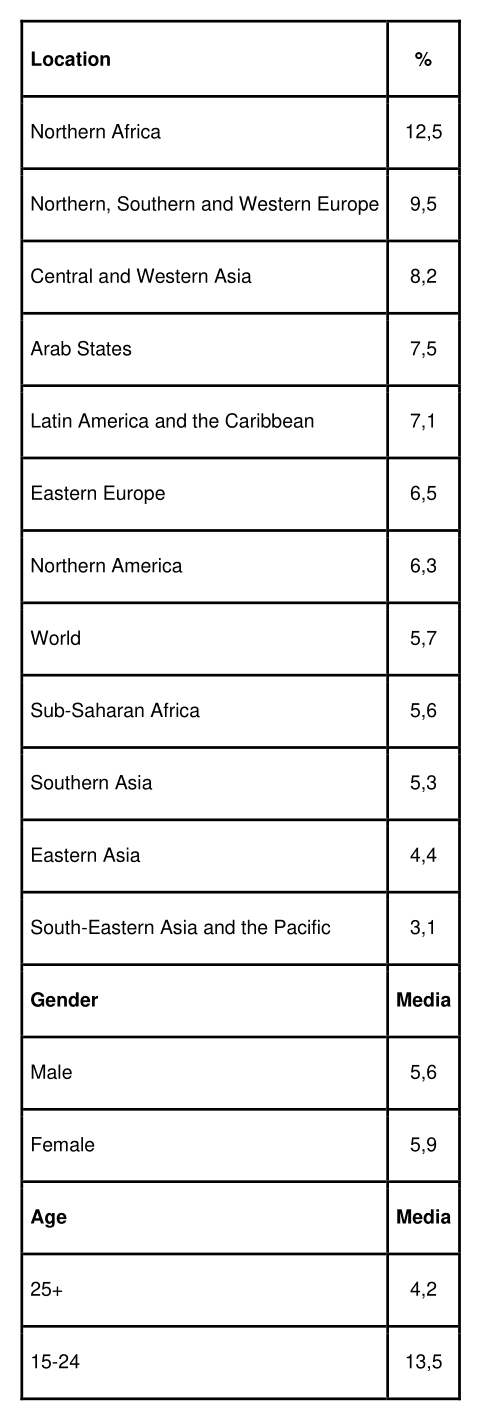
The data were taken from the ILO Trends Econometric Models (ilo.org/wesodata)
Curiously, Sub-Saharan Africa does not seem to suffer much from this phenomenon, but we can soon explain the difficulties of these nations if we also look at the phenomenon of underemployment. As shown by the graph below, the situation is very different geographically, placing Africa in a position of severe hardship.
Chart 1 - In-work poverty rate by geographical area (% of employed persons living below USD 1.90 per day)
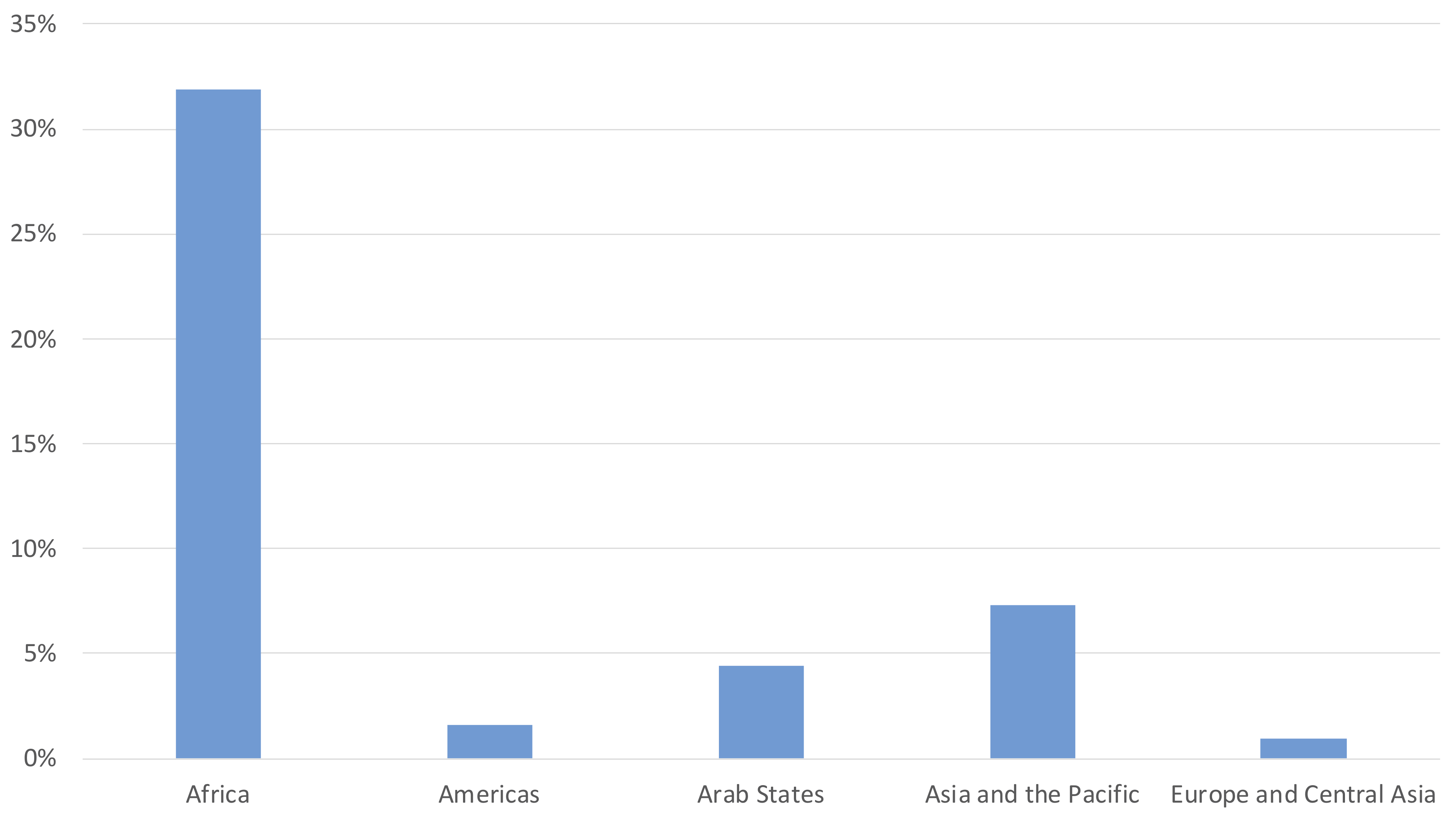
The data were taken from the ILO Trends Econometric Models (ilo.org/wesodata)
Again, women are more affected by this phenomenon, albeit with a slight difference and, as seen from the graph below, within a phenomenon that has significantly improved in recent years.
Chart 2 - In-work poverty rate by gender (% of employed persons living below USD 1.90 per day)
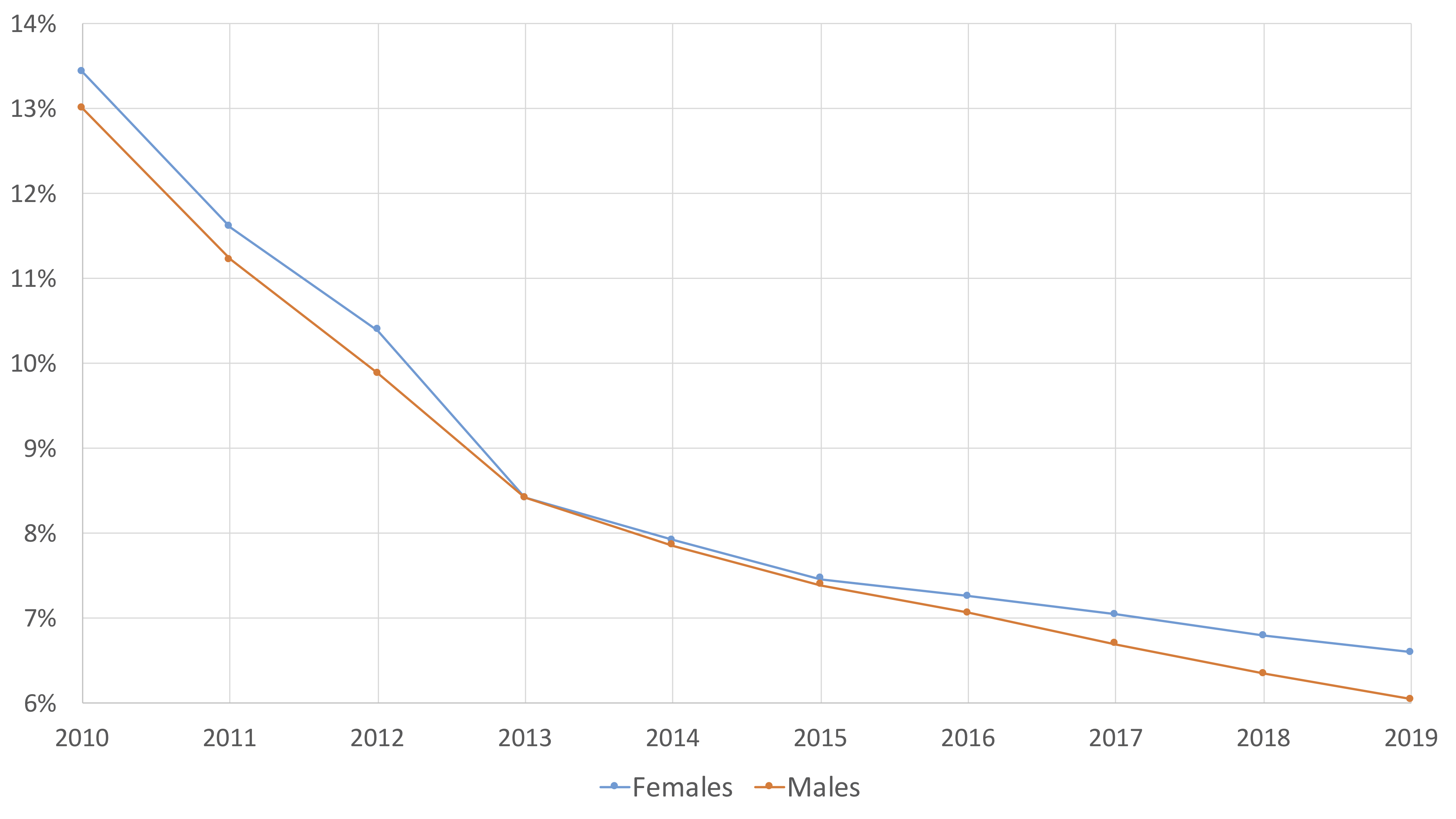
The data were taken from the ILO Trends Econometric Models (ilo.org/wesodata)
These data justify the urgency, declared by the Church, to address the problem of unemployment to respond to needs that may vary from context to context: “While it is alarming in the developing countries, with their high rate of population growth and their large numbers of young people, in the countries of high economic development the sources of work seem to be shrinking, and thus the opportunities for employment are decreasing rather than increasing” (Sollicitudo rei socialis, 18). The lack of work is one of the leading causes of the emergence of the poor who “appear in various places and at various times; in many cases they appear as a result of the violation of the dignity of human work: either because the opportunities for human work are limited as a result of the scourge of unemployment, or because a low value is put on work and the rights that flow from it, especially the right to a just wage and to the personal security of the worker and his or her family” (Laborem exercens, 8). The feeling of insecurity is a further consequence that deserves particular attention: “uncertainty over working conditions caused by mobility and deregulation, when it becomes endemic, tends to create new forms of psychological instability, giving rise to difficulty in forging coherent life-plans, including that of marriage. This leads to situations of human decline, to say nothing of the waste of social resources. In comparison with the casualties of industrial society in the past, unemployment today provokes new forms of economic marginalization, and the current crisis can only make this situation worse” (Caritas in veritate, 2009, 25).
Work is one of the ways for society to guarantee the right to a dignified life, but for this to happen, it must not only be available but also be dignified and sufficiently stable. By ‘stable’, we do not necessarily mean ‘guaranteed with an open-ended contract’, but more as being accessible with sufficient ease, the lack of which is occasional and perceived as such. The scarcity of employment opportunities, finally, can fuel contractual forms that are weak in guaranteeing workers’ minimum rights, such as an excessive use of temporary contracts, in which people are hired ‘already fired’; or a distorted use of apprenticeships, as a work activity and not as training and orientation; or, finally, the contractual forms of the ‘gig economy’, in which the worker interacts exclusively with an app on his mobile phone that gives instructions created by an algorithm. To these contractual forms must be added all the undeclared labour, which is more characteristic of developing countries and explains, at least in part, the phenomenon of underemployment mentioned above.
The causes of these ‘non-full’ forms of employment lie first and foremost in “treating work as a special kind of “merchandise”, or as an impersonal “force” needed for production (the expression “workforce” is in fact in common use)” (Laborem exercens, 7), with the risk that “making market mechanisms the only point of reference for social life [while] an abundance of work opportunities, a solid system of social security and professional training, the freedom to join trade unions and the effective action of unions, the assistance provided in cases of unemployment, the opportunities for democratic participation in the life of society – all these are meant to deliver work from the mere condition of “a commodity”, and to guarantee its dignity” (Centesimus annus, 19). They are, moreover, to be found in the “technological progress in which the costs of production are reduced by laying off workers and replacing them with machines” (Laudato si’, 2015, 128), and therefore in “an obsession with reducing labour costs with no concern for its grave consequences, since the unemployment that it directly generates leads to the expansion of poverty” (Fratelli tutti, 2020, 20). The replacement of humans by machines, which today are also complex artificial intelligence systems performing intellectual tasks, is not a negative phenomenon insofar as they relieve workers of the most monotonous and physically demanding tasks. The problem is that they do not replace part of each worker’s load but make some professions completely replaceable, while they tend to overload others who, under the banner of ‘smart working’, are finding it increasingly difficult to carve out time but also physical spaces, that help them balance personal and working life.
Vocational satisfaction
Francis reminds us that “We were created with a vocation to work. […] Work is a necessity, part of the meaning of life on this earth, a path to growth, human development and personal fulfilment” (Laudato si’, 128). According to the Church’s social doctrine, therefore, work does not only respond to the primary need for survival but also to the need for personal fulfilment, and it is only to the extent that it can respect the subjectivity of the individual, his predispositions, motivations and actual working capacities. Francis translates this into “the opportunity to nurture the seeds that God has planted in each of us: our talents, our initiative and our innate resources” (Fratelli tutti, 162) and goes a step further than what is stated in Laborem excercens when he speaks of the “issue of suitable employment for all who are capable of it. The opposite of a just and right situation in this field is unemployment, that is to say the lack of work for those who are capable of it” (Laborem exercens, 18), while recognising that there must be room for people with limited capacities: “A truly human and fraternal society will be capable of ensuring in an efficient and stable way that each of its members is accompanied at every stage of life. Not only by providing for their basic needs, but by enabling them to give the best of themselves, even though their performance may be less than optimum, their pace slow or their efficiency limited” (Fratelli tutti, 110).
In this ‘being able’, we can, therefore, read attention to the uniqueness of the individual and the need to respect this both for the satisfaction of the workers themself and for the employer and society as a whole, which would undoubtedly benefit from the presence of a motivated and competent worker. From this, we can draw two indications. The first is to activate initiatives specifically designed to help people become, on the one hand, more aware of their predispositions, abilities and motivations and, on the other hand, more competent in reading the labour market so that they can make more satisfying career choices for themselves and others. The transition from ‘job’ to ‘career path’, which is first and foremost a change of attitude, is crucial to prevent people from becoming excessively flattened by having a job and from projecting themselves with increasing conviction towards a ‘professional vocation’.
The second consequence is that all those operations that attempt to solve the hardships associated with unemployment by providing subsidies without a real prospect should be viewed with suspicion. On the one hand, it is true that “The obligation to provide unemployment benefits, that is to say, the duty to make suitable grants indispensable for the subsistence of unemployed workers and their families, is a duty springing from the fundamental principle of the moral order in this sphere, namely the principle of the common use of goods or, to put it in another and still simpler way, the right to life and subsistence” (Laborem exercens, 18). On the other hand, “Helping the poor financially must always be a provisional solution in the face of pressing needs. The broader objective should always be to allow them a dignified life through work” (Laudato si’, 128) because “Being out of work or dependent on public or private assistance for a prolonged period undermines the freedom and creativity of the person and his family and social relationships, causing great psychological and spiritual suffering” (Caritas in veritate, 25).
Social Footprint
“God encourages us to develop the talents he gave us, and he has made our universe one of immense potential. In God’s plan, each individual is called to promote his or her own development, and this includes finding the best economic and technological means of multiplying goods and increasing wealth” (Fratelli tutti, 123). Work, therefore, is also an opportunity to enable people to leave an imprint on society: “Since production systems may change, political systems must keep working to structure society in such a way that everyone has a chance to contribute his or her own talents and efforts” (Fratelli tutti, 162). But the lack of contribution depends not only on unemployment due to political and economic issues. Some people do not feel it is their duty to contribute to the development of society with their work while feeling co-responsible for the betterment of the world should be a welcome moral obligation. This is true for entrepreneurs, whose skills “should always be clearly directed to the development of others and to eliminating poverty, especially through the creation of diversified work opportunities” (Fratelli tutti, 123), but also for the unemployed themselves, who sometimes pay little attention to their professionalism, to keeping it up-to-date, to merely claiming the right to work while forgetting the equally important dimension of duty.
Dignified existence
Equally important is work’s role in guaranteeing people a dignified existence. Laborem exercens was the first encyclical to “highlighting the deontological and moral aspect. The key problem of social ethics in this case is that of just remuneration for work done” (Laborem exercens, 19), which is just not only about the service provided, but also the ability to guarantee sustenance and a decent life for oneself and one’s family. To this must be added that the reduction of jobs also has a negative impact on the economic level “through the progressive erosion of “social capital”: the network of relationships of trust, dependability, and respect for rules, all of which are indispensable for any form of civil coexistence [...] Human costs always include economic costs, and economic dysfunctions always involve human costs” (Caritas in veritate, 32). Francis, in continuity with some previous contributions, recalls the importance of social movements as “sowers of change, promoters of a process involving millions of actions, great and small, creatively intertwined like words in a poem [adding that it is necessary to go] beyond the idea of social policies being a policy for the poor, but never with the poor and never of the poor, much less part of a project that reunites peoples” (Fratelli tutti, 169).
Possible solutions
The causes of unemployment can be found mainly in structural and individual elements. We have already mentioned the structural ones, which refer to the employment relapse of weak economies or robotisation. To these must be added all those aspects of labour regulations and contracts that could be improved to guarantee the emergence of undeclared work and decent employment while respecting the costs for the company that, if high, deprive it of the possibility of investment, if not of survival itself. The solution can therefore be found, at least in part, in an intervention by the state that can be indirect “according to the principle of subsidiarity, by creating favourable conditions for the free exercise of economic activity, which will lead to abundant opportunities for employment and sources of wealth . Directly and according to the principle of solidarity, by defending the weakest, by placing certain limits on the autonomy of the parties who determine working conditions, and by ensuring in every case the necessary minimum support for the unemployed worker” (Centesimus annus, 15).
The individual elements, on the other hand, refer to everything that can be done to make people more suited to the needs of the labour market, respecting their aptitudes and motivations. Much has been said about the importance of initial and updating training, which requires adequate resources, but also the addressing capacity of policymakers and the willingness for retraining on the part of workers. Much more difficult, on the other hand, is to find references to the workers’ competence in managing their career, that is, in making scholastic, training and work choices that make them effective in moving ever closer to that occupation that represents the greatest satisfaction for them and the socio-economic system. These choices are today much more complicated than in the past and therefore require career education interventions, which schools could provide if they had adequate resources, especially professional ones, and systems of labour market analysis and information on training and employment offers, which are often ineffective if not totally absent.
It should be added that, at least in part, the solution also lies in the individual’s willingness to deal with a changed and constantly changing context, within which are rewarded the people who invest in qualification and retraining, who ask themselves what contribution they can make to the economic system by being more attractive and, consequently, having more opportunities for choice. The epochal shift, for systems and individuals, will be the cultural one that will replace the search for employment with building one’s own career.
Bibliografia
Sitography
https://ilostat.ilo.org/topics/unemployment-and-labour-underutilization/
https://ilostat.ilo.org/topics/working-poor/
Autore
Diego Boerchi, Università Cattolica del Sacro Cuore (diego.boerchi@unicatt.it)