


×
Desideri ricevere notizie dal Centro di Ateneo per la dottrina sociale della Chiesa dell’Università Cattolica del Sacro Cuore?

Fascicolo 2023, 3 – Luglio-Settembre 2023
Prima pubblicazione online: Settembre 2023
ISSN 2784-8884
DOI 10.26350/dizdott_000132
di Emilio Colombo, Mario A. Maggioni
Abstract:
ENGLISH
Il lavoro è più di un fattore di produzione; esso implica il coinvolgimento della persona umana nella sua interezza, relazionalità, capacità di conoscenza. La diffusione dell’I.A. e il conseguente approccio al lavoro basato sui compiti, rischia di frammentare questa unità rendendo labile il confine tra il lavoro umano e quello delle macchine. È responsabilità della scienza, dell’economia e della politica far si che la transizione delle competenze richieste dal mercato del lavoro sia un’occasione di inclusione e non di discriminazione.
Parole chiave: Tecnologia, Lavoro, Occupazione, Compito, Competenze, Dignità del lavoro
ERC:
ITALIANO
Labor is more than a production factor. It implies the involvement of the human being in its wholeness, relationality, knowledge capacity. The diffusion of A.I. and the consequent task-based approach to labor makes the boundary between men and machine fuzzy. Science, Economics and Politics should take their own responsibility to govern the transition in the competences required by the labor market and make them an opportunity for inclusion rather than the engine of discrimination.
Keywords: Technology, Labour, Work, Task, Skill, Job, Dignity of work
ERC:





What is labor?
If one starts by reading a manual of introductory microeconomics, one might think that, according to economic theory, Labor is simply an input, a factor of production just like capital; being functionally similar to This resemblance to capital even leads to the use of the term ‘human capital’ for this purpose. Therefore, it seems that labor would be subject to the same rules and considerations as capital. For instance, human capital can be accumulated, undergo phenomena of depreciation, and wear and tear, and ultimately display diminishing marginal returns, much like physical capital.
However, the social teachings of the Church emphasize a different perspective, emphasizing the primacy of Labor over Capital. In the words of Laborem exercens (1981, 12) – «labour is always a primary efficient cause, while capital, the whole collection of means of production, remains a mere instrument or instrumental cause». Simultaneously, these teachings stress the essential mutual dependency of the two. As stated in Rerum novarum (1891, 15) almost hinting at a specific production function in which labor and capital are intertwined multiplicatively. This depiction implies that to yield an output greater than zero, both inputs must be present, even if one is present only in a minimal quantity. In essence, if either capital or labor were reduced to zero, their combined product would inevitably become zero as well.
1.1. Labor, human capital and knowledge
Indeed, microeconomic theory itself has underscored that labor possesses distinct characteristics warranting differential treatment compared to capital–even when it’s reduced to the concept of ‘human capital’. While labor is susceptible to depreciation, wear and tear, and obsolescence, it also experiences value appreciation through utilization. This phenomenon has always been present, but its significance has markedly grown, particularly since human labor no longer merely entails basic ‘animal power’. Instead, it has evolved through a lengthy process, marked by two pivotal phases: the industrial revolution and the subsequent computer revolution involving networks and artificial intelligence. This evolution has predominantly hinged on the intellectual and creative capacities of individuals.
In this context, it is impossible to discuss human work without delving into knowledge. When discussing knowledge, a comprehensive grasp of its dynamics necessitates exploring the concept of learning, as outlined by various authors in their insightful descriptions. These authors have masterfully outlined different learning modalities: ‘learning by doing’, as defined by Kenneth Arrow in his 1962 article; ‘learning by using’, as identified by Nathan Rosenberg in his 1982 book; and finally, ‘learning to learn’, pinpointed by Joseph Stiglitz in his 1987 essay.
The first modality (learning by doing) pertains to the intrinsic link between work and learning. In the process of executing a specific work task, one indirectly acquires improved skills by performing it. The second modality (learning by using) captures the inherent dynamic where using a tool or technology created by others leads the user to generate knowledge about the tool’s usage through their own work. This knowledge becomes valuable not only to the user but also to the tool’s producer. Lastly, the third modality (learning to learn) encapsulates the essence of the learning process itself: it operates under increasing returns. As one gains knowledge, expertise in the learning process also expands. Consequently, this expertise accelerates the acquisition of new knowledge, building upon the foundation of previous learning experiences.
1.2. Work between utility and disutility
At times, labor is, however, perceived in a narrow manner and classified within the microeconomic framework as a ‘negative’ force, signifying a phenomenon that generates dissatisfaction. In the opening chapters of labor economics textbooks, the construction of a worker’s supply curve begins by plotting a graph where the worker’s decisions are depicted through points in a space where two commodities are measured: income and leisure. Thus, if leisure is the commodity yielding contentment upon consumption, conversely, it is tacitly assumed that ‘work time’ leads to discomfort and that labor is undertaken by the worker solely to attain income (or a salary).
This interpretation overlooks the reality that work can also serve as a wellspring of contentment, fulfillment, and honor. The domains of information and behavioral economics have recently acknowledged this phenomenon as ‘intrinsic motivation’ or ‘incentive’. The encyclical Laborem exercens (1981) explicitly acknowledged the inherent value of work itself, underscoring its importance beyond mere financial gain, «as a sharing in the activity of the Creator» (25), and Gaudium et spes states: «For while providing the substance of life for themselves and their families, men and women are performing their activities in a way which appropriately benefits society. They can justly consider that by their labor they are unfolding the Creator’s work» (Gaudium et spes, 1965, 34). Beyond being solely of interest to economic theory, the reductionist view of work has led to a situation where unemployment, for years, has been perceived primarily as an issue related to the absence of income, and has been addressed through ‘unemployment benefits’, often disregarding the other motivational repercussions linked to this circumstance. In order to rectify this narrow perspective, the European Union has shifted the focus of its welfare strategies, progressively transitioning from passive labor policies to active ones. This shift encompasses a broader framework termed ‘Social Investment’, which seeks to equip individuals, families, and societies to effectively respond to the novel challenges of a knowledge-driven economy. This is achieved by fostering an ongoing investment in human capital, spanning from childhood to adulthood, with the aim of ‘activating’ and ‘empowering’ individuals.
As Emmanuel Mounier aptly noted, ‘working involves the simultaneous creation of both a person and an object’. Consequently, the absence of work can significantly impact a person’s sense of identity and unity. It’s not coincidental that Laborem exercens, in paragraph 9, states: «through work man not only transforms nature, adapting it to his own needs, but he also achieves fulfilment as a human being and indeed, in a sense, becomes ‘more a human being’».
Technology and labor
The economic literature has frequently highlighted the positive impact of technological advancement as a potent, if not the primary, catalyst for economic growth. Although from a macroeconomic perspective, the overall outcome of technological progress is affirmative (over the past century, technology has propelled major advanced nations to achieve unprecedented growth rates, accompanied by a notable rise in both male and female employment rates), its benefits haven’t been universally shared. In the subsequent sections, three closely intertwined concepts will be consistently referenced, each possessing distinct meanings that warrant clarification: job, task, and skill. The term ‘job’ pertains to work activities in the sense of occupation; ‘task,’ on the other hand, defines a specific, delineated activity that typically forms a component of a job. Lastly, ‘skill’ alludes to competencies encompassing formal knowledge and abilities, acquired through formal educational avenues (such as schools, universities, and vocational training) and non-formal sources (like the internet, media, or on-the-job experience), along with informal skills acquired through daily life or linked to an individual’s innate traits.
2.1. How technology transform work and labor
Using a terminology typical of economists, we can say that technological progress impacts labor along two main directions. A first is what we can call the extensive margin, i.e. the capacity of technological progress to create new jobs and to destroy existing ones (e.g. the invention of the automatic lift has eliminated the work of the lift operator or ‘lift-boy’). A second direction is what is called the intensive margin: in this case, technological progress transforms existing jobs by changing the skills required to perform them (nowadays a gardener uses a range of electrical equipment that makes his work more efficient and less tiring, but which in essence has remained very similar to that of his predecessors a century ago). As we shall see in the following section, the extensive margin has to do with work (job), while the intensive margin with activities or tasks (task).
Overall, the combination of these two strands has been positive mainly because the speed with which technological progress has transformed the labor market has been generally compatible with workers’ ability to adapt to change. In particular, technology and human capital have been strongly complementary in the sense that technology has guaranteed a skill premium (which, depending on the different institutional contexts of different countries, can be more or less relevant: the following table highlights the US case where the skill premium, approximated in the table by the qualifications obtained, is particularly relevant) that could be captured by those who invested more in education.
Table 1
Unemployment rates and earnings by educational attainment (2021)
Source: https://www.bls.gov/emp/tables/unemployment-earnings-education.htm
This notion becomes evident right from the outset in Becker’s foundational theories, as well as in later empirical research by scholars like Acemoglu. Italy serves as an illustrative example: despite having a lower percentage of university graduates compared to the European average, the salary disparity between university graduates and individuals without degrees of the same age is among the smallest. This occurs even if a higher level of qualification, on average, enhances an individual’s chances of securing employment.
It’s important to recall that the social doctrine of the Church also underscores the positive aspects of technological advancement. It «touches the heart of the vocation of human labour: in technology, seen as the product of his genius, man recognizes himself and forges his own humanity» (Caritas in veritate, 2009, 69). Indeed, technology is an expression of human creativity; enabling humanity to exert control over the physical world and enhance the quality of life. Nonetheless, the social doctrine of the Church cautions against the dangers that emerge when the deeply interconnected relationship between technology and humanity is disrupted. In such a scenario, technological advancement can take on a self-referential nature, and its potential negative consequences can outweigh its benefits and «can give rise to the idea that technology is self-sufficient when too much attention is given to the “how” questions, and not enough to the many “why” questions underlying human activity» (Caritas in veritate, 70).
2.2. A task-based approach to labor
The rapid acceleration of technological progress, particularly its pervasive influence in recent years, has amplified these risks. This situation simultaneously demands a departure from the traditional standpoint often found in economic literature. The line distinguishing between human labor and machine labor is progressively fading. Digital technologies and artificial intelligence are increasingly intertwined with human tasks, rendering it challenging to differentiate between human and automated work. In economic discourse, the task-based approach is emerging. It draws inspiration from the global value chain of international trade, where a product is fragmented into distinct stages, each treated as a separate entity and produced in various countries based on the principle of comparative advantage. Similarly, employment (jobs) is ‘deconstructed’ into individual tasks. These tasks can be carried out by either humans or machines (hardware or software, or a combination of both) based on their respective comparative advantages. In this approach, the focus of analysis shifts from jobs to tasks. Simultaneously, there is a notable emphasis on competencies (skills) as they determine the specific activities in which individuals can specialize.
Table 2
Emerging skills (Italy)
Source: World Economic Forum, The Future of Job Report 2020
Skills identified as being in high demand within their organization, ordered by frequency
The shift in concept is apparent: the unified notion of work executed by an individual is no longer applicable. When work is reduced to a mere aggregation of tasks, it becomes detached from the individual and transforms into a mere activity that can be carried out interchangeably by a person, a machine, or an algorithm. This evolution markedly departs from the Church’s social doctrine’s unified perspective on work, where the inherent worth of work lies in its performance by a person. Hence, dissociating work from the individual diminishes its inherent dignity.
Labor and technology in industrial revolutions
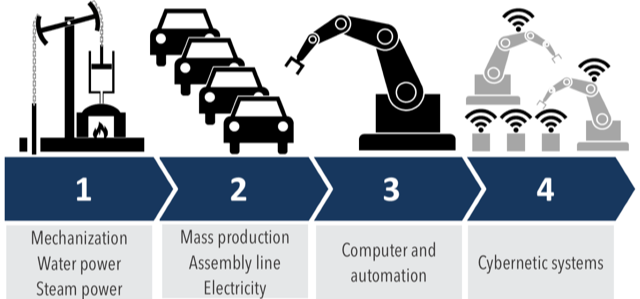
Examining the dynamics characterizing the initial Industrial Revolution reveals that one of its most transformative elements was the invention (attributed to Papin and Newcomen) and subsequent refinement (by Watt) of the steam engine. This directly led to mechanized manufacturing processes and indirectly triggered a series of social and technological phenomena. These include standardized mass production, assembly line techniques, statistical quality control through sampling, and even the conceptualization of Charles Babbage’s groundbreaking project, the ‘Analytical Machine’.
Throughout history, technology and technological revolutions have always intersected with both the physical and mental realms – pertaining to tangible objects and abstract ideas alike. Consequently, two parallel processes have accompanied the most substantial improvements in human well-being ever recorded (as measured, for instance, by GDP per capita): firstly, the use of machines to replace human (and animal) labor and energy for increasingly intricate manual tasks, and secondly, the deployment of machines (alongside written instructions such as codes or software) to supplant certain cognitive functions of the human mind.
Certainly, akin to any transition, the advent of ‘Industry 4.0’ (a term denoting the integration of new technologies – like smart factories, cloud computing, and big data analytics – into industrial automation to enhance working conditions, create novel business models, amplify production efficiency, and elevate product quality) will yield both beneficiaries and those who experience setbacks, will produce winners and losers.
Figure 1 - Industry 4.0
Source: Wikipedia
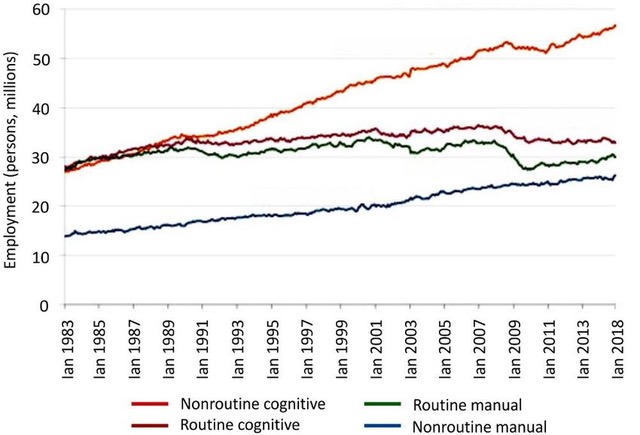
Certainly, the occupations most susceptible to disruption are those involving repetitive tasks from both a manual and cognitive standpoint, often referred to as routine activities. These tasks can be effectively undertaken by machines or algorithms. They encompass numerous administrative functions that have been transformed by the introduction of management software, as well as basic manual tasks like assembly work. Conversely, occupations demanding intricate activities, whether of an intellectual nature such as analysis, contemplation, judgment, and evaluation, or relational in essence, like those related to comprehensive personal care, are less vulnerable. This is because these roles entail activities that are challenging to replace with technology.
While estimations regarding the impact of recent technological revolutions–compiled by consulting firms (like Deloitte in 2021) and think tanks–vary widely (ranging from highly alarmist to more reassuring), it’s undeniable that recent innovations have empowered machines and algorithms to execute complex tasks once believed to be solely within human capability. Consider, for instance, the cognitive abilities necessary for the role of a taxi driver, involving intricate evaluations and judgments, which are now under threat due to the emergence of self-driving vehicles.
Table 3
Predicted Jobs Automation Will Create and Destroy
Source: MIT Technology Review
In this context, it is crucial to design appropriate (industrial and labor) economic policies guiding society through the technological transition and facilitating those adversely affected by technological progress in minimizing their losses. Educational policies play a pivotal role in this endeavor. Notably, recent technological advancements have increasingly favored (as depicted in Figure 2) two key categories of skills: cognitive abilities on one side and non-routine manual skills on the other. This presents a significant test for the education system encompassing both formal education and vocational training. These avenues must equip individuals with the fresh skills demanded by the emerging technologies.
Figure 2 - Evolution of employment by different skills
3.1. The relational dimension of Labor and the role of intelligence
The latest research concerning the skills highly sought after in the job market underscores the significance of social skills and versatile competencies, often referred to as ‘soft skills’. This emphasis not only underscores the integration of work and the individual but also underscores another facet of work that the social doctrine of the Church strongly accentuates. Work has a fundamental social dimension «In our time […] More than ever, work is work with others and work for others» (Centesimus annus, 1991, 31).
The unitary and relational dimensions represent two distinctive qualities through which the social doctrine of the Church advocates for a fresh perspective on work. The etymology of the term ‘intelligence’ aids in comprehending the profound message; it originates from two roots that accentuate both a vertical and horizontal direction. On one hand, ‘intelligence’ stems from ‘intus-legere’, signifying the capacity to apprehend reality not superficially, but by delving deeper to grasp concealed and less evident facets. On the other hand, ‘intelligence’ originates from ‘inter-legere’, conveying the ability to perceive what lies between the lines, and to discern correlations and interrelationships, thereby unveiling connections and links between the various facets of reality. This leads to a broader and more comprehensive understanding of the whole. Both these roots are integral to the meaning of work articulated within the social doctrine of the Church. Work stands as the force that imparts dignity to humanity, granting individuals the opportunity to engage in the very act of God’s creation (vertical dimension). Simultaneously, work embodies a cooperative endeavor undertaken by individuals to uplift their fellow human beings, entailing an inherent relational element (horizontal dimension).
The interaction with artificial agents introduces a profound novelty to the structure of social life (as noted in Comece, 2019; Gaggioli et al., 2021; Pontificia Academia Scientiarum, 2020), demanding a revision of categories and ethical guidelines. When we consider the principles outlined in the Declaration of Rome (2020) that are anticipated to guide the development of artificial intelligence – transparency, inclusivity, accountability, impartiality, reliability, security, and privacy – they collectively revolve around safeguarding human dignity and enabling each individual to voice and cultivate themselves. The intrinsic connection between these principles and the previously stated concept of work is evident.
Hence, it becomes imperative to labor towards ensuring that the integration and dissemination of new technologies do not undermine the crucial bond between humanity and work. This endeavor is formidable, the task demanding; yet, each individual can contribute their part: scientific, technological, and engineering fields must pinpoint the distinct capabilities inherent in humans that render them irreplaceable in certain professions. The realms of business and economics must approach this process not solely from a limited, short-term profit-maximization stance, while politics should propose investment and social transformation plans to accompany and direct the ongoing transformations. This would facilitate the smooth transition of skills and professions during this transformative period.
Pope Francis, in his speech on 28 February 2020 prepared for the plenary assembly of the Academy for Life emphasises how «There are many disciplines involved in the process of developing technological equipment (one thinks of research, planning, production, distribution, individual and collective use…), and each entails a specific area of responsibility. We are beginning to glimpse a new discipline that we might call “the ethical development of algorithms” or more simply “algor-ethics”. This would have as its aim ensuring a competent and shared review of the processes by which we integrate relationships between human beings and today’s technology. In our common pursuit of these goals, a critical contribution can be made by the principles of the Church’s social teaching: the dignity of the person, justice, subsidiarity and solidarity. These are expressions of our commitment to be at the service of every individual in his or her integrity and of all people, without discrimination or exclusion».
In this process, the Church’s social doctrine is a companion to humanity because, as Eliot said in the “Choruses from The Rock”: «There is work together. A Church for all. And a job for each. Every man to his work».
Bibliografia
• Baldwin R. (2019), The Globotics Upheaval: Globalisation, Robotics and the Future of Work, Oxford University Press.
• Colombo E. (2022), Uomo, Macchine e Intelligenza Artificiale: Sostituti o Complementi nel Lavoro del XXI Secolo? in AA.VV., Intelligenza artificiale e uomo, Edizioni Rezzara.
• Deloitte AI Institute (2021), The future of AI. Seeing the forest for the trees, and the forests.
• Gaggioli A., Chirico A., Di Lernia D., Maggioni M.A., Malighetti C., Manzi F., Marchetti A., Massaro D., Rea F., Rossignoli D. and Sandini G. (2021), Machines Like Us and People Like You: Toward Human–Robot Shared Experience, «Cyberpsychology, Behavior, and Social Networking», 24(5), pp. 357-361.
• Pontificia Academia Scientiarum (2017), Power and Limits of Artificial Intelligence. Proceedings of the Workshop 30 November - 1 December 2016.
Autori
Emilio Colombo, Università Cattolica del Sacro Cuore (emilio.colombo@unicatt.it)
Mario A. Maggioni, Università Cattolica del Sacro Cuore (mario.maggioni@unicatt.it)
