


×
Desideri ricevere notizie dal Centro di Ateneo per la dottrina sociale della Chiesa dell’Università Cattolica del Sacro Cuore?

Fascicolo 2024, 4 ‒ Ottobre-Dicembre 2024
Prima pubblicazione online: Dicembre 2024
ISSN 2784-8884
DOI 10.26350/dizdott_000167
Abstract:
ENGLISH
L'articolo si propone di delineare la potenziale circolarità tra abbondanza e condivisione che può rendere generativo lo sviluppo economico, alla luce dell’Economia Sabbatica (Guarini e Zanotelli, 2024) e del principio della destinazione universale dei beni. Si illustreranno i fattori che promuovono e ostacolano questo potenziale circolo virtuoso, con riferimento alla dicotomia tra ricchezza accumulata e abbondanza condivisa, al fine di offrire una chiave di lettura per comprendere alcune criticità dell'economia attuale, valutarne la gravità e proporre percorsi di riforma.
Parole chiave: Abbondanza, Condivisione, Economia sabbatica, Economia generativa, Destinazione universale dei beni
ERC: SH1_1, SH1_3, SH1_11
ITALIANO
The article aims to outline the potential circularity between abundance and sharing that can make economic development generative, in the light of Sabbath Economics (Guarini and Zanotelli, 2024) and of the principle of the universal destination of goods. It will set out the factors that promote and hinder this potential virtuous circle, with reference to the dichotomy between accumulated richness and shared abundance, in order to offer a key to understanding some criticalities of the current economy, assessing their seriousness and proposing avenues for reform.
Keywords: Abundance, Sharing, Sabbath Economics, Generative economy, Universal destination of goods
ERC: SH1_1, SH1_3, SH1_11





The generative circle of economic development
The article aims to outline the potential circularity between abundance and sharing that can make economic development generative, in the light of Sabbath Economics (Guarini and Zanotelli, 2004). It will set out the factors that promote and hinder this potential virtuous circle, with reference to the dichotomy between accumulated richness and shared abundance, in order to offer a key to understanding some criticalities of the current economy, assessing their seriousness and proposing avenues for reform.
Sabbath economics is the vision based on the social and economic justice illustrated in the Bible through the story of the manna (Exodus 16), the legislation of Leviticus (Leviticus 2), the prophetic sayings (Isaiah 5 et al.), the sayings and parables of Jesus, and the practices of the first Christian communities. It is based on the Sabbath rest (for workers and land), on the principles of “enough for all” and “not accumulation for the few”, and on debt justice. God gives Israel abundant manna in the desert to survive, and gives the rules for sharing it. Today, thanks to technological capabilities, the economic system can produce “manna” enough for all, in terms of goods and services, technological and financial resources and knowledge. The problem, then, is how this potential abundance can be generative, favouring the promotion of integral human development, defined as development for all persons and for the whole person (cfr. Populorum progressio, 1967, 42), where on one hand abundance can improve the quality of life through sharing and on the other hand, sharing can lead to economic progress. Thus, in this view sharing cannot be reduced to mere distribution and at the same time economic development – even if it is more evenly distributed among the population – is not in itself capable of generating integral human development. According to Pope Francis, integral human development is not reduced to income and the consequent access to the goods necessary for life, but requires that the poorest can be «dignified agents of their own destiny» (Address to the United Nations, 2015), which obviously moves the problem beyond economic dynamics.
This circular interaction between abundance and sharing in order to improve the quality of life must be ecologically sustainable. Specifically, it has to fit within the situated anthropocentrism, according to which human beings have «the unique and central value amid the marvellous concert of all God’s creatures» and «human life is incomprehensible and unsustainable without other creatures». Moreover, «[…] as part of the universe … all of us are linked by unseen bonds and together form a kind of universal family, a sublime communion which fills us with a sacred, affectionate and humble respect» (Laudate Deum, 2023, 67). This anthropocentrism overcomes two extremes: on the one hand, ecological problems can only be solved by technological progress without any relevant changes and ethical considerations; on the other hand, «the presence of human beings on the planet should be reduced and all forms of intervention prohibited» (Laudato si’, 2015, 60). This vision is opposed to the neoliberalism that dominates current capitalism and represents the mainstream theory and policy, based on the seminal concept of homo oeconomicus: a materialistic and egoistic monade that maximises its own individual goals (profit, utility,…), without any social interests and uninfluenced by relationships.
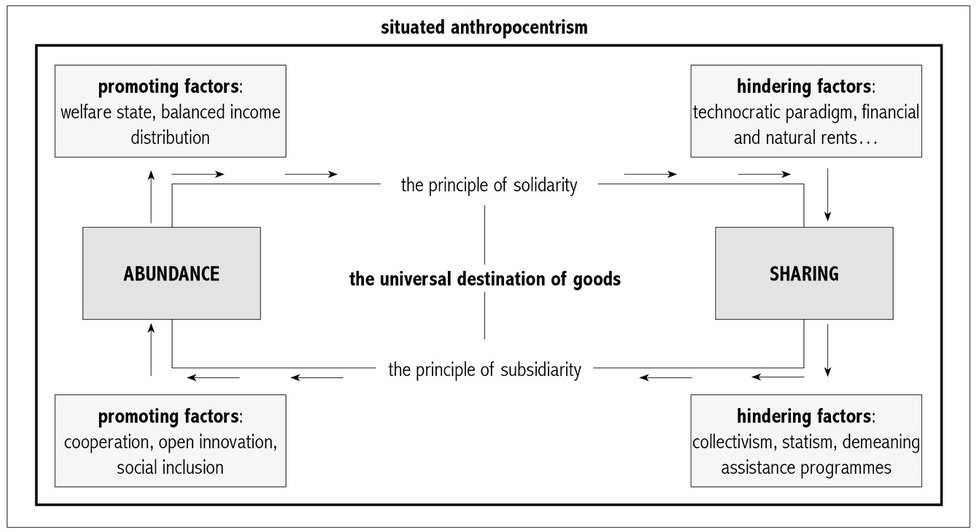
Instead, within the classical-post-Keynesian paradigm (Roncaglia, 2019; Pasinetti, 2007, Sen, 2000) and the generative literature with social and civil economy (Becchetti et al. 2024), it is possible to conduct an analysis of a circularity between abundance and sharing where agents are connaturally interconnected with a combination of self-interest and altruism, and economic development is seen as instrumental to social progress and civic development at the individual and community levels. In particular, with regard to generative studies that focus mainly on creativity and social responsibility at the microeconomic level, we aim to lay the foundations for a generative approach to the analysis of economic development, with particular reference to the main principles of the Social Catholic Thought: the universal destination of goods, solidarity and subsidiarity. From this optic, the Sabbath Economics and the generative literature can be considered complementary: the former can be the source of inspiration for the latter. In Figure 1, within the circle between abundance and sharing there are factors that can favour (promoting factors) the sharing of abundance such as the welfare state, a balanced distribution of income in the light of principle of solidarity as well as factors that can hinder this sharing (hindering factors) such as the technocratic paradigm, financial and natural rents. There are factors (promoting factors) that can sustain the transformation of sharing in abundance (promoting factors) such as cooperation, open innovation, social inclusion according to the principle of subsidiarity, as well as factors that can obstruct this generation of development (hindering factors) such as collectivism, statism, demeaning assistance programmes. Finally, the architrave of this framework is the principle of the universal destination of goods which combine the two principles of solidarity and subsidiarity.
Figure 1. The generative circle of economic development
Source: author’s contribution.
Let us illustrate in detail the generative cycle of economic development (Figure 1).
From abundance to sharing
Since the industrial revolution, the global economic system has experienced an extraordinary rise in income per capita. This economic success has brought significant social improvements, but it has also entailed growing social and environmental costs that are now unsustainable. On the one hand, recent years have been seen an increase in inequalities at international, national and regional levels: inequalities between territories, social groups, social classes; on the other hand, we are contributing to a dangerous and widespread climate change, environmental degradation and extreme pollution. In fact, the neoliberal “trickle down” principle – according to which an economic improvement of the upper classes will benefit all people – does not work; it represents a theoretical and political justification for strengthening the economic power of a few. It can therefore be considered a kind of «dogma of the neoliberal faith» (Fratelli tutti, 2020, 168). Generally speaking, before the industrial revolution, the main economic problem was the fight against the structural scarcity of goods: the economic crisis was mainly caused by an excess of demand. After the explosion of technological progress, the main economic problem becomes abundance, and economic crises are mainly related to an excess of supply (indeed, Keynes points out the relevant role of aggregate demand to balance the tendency of overproduction and of fiscal policy to overcome recessions). Thus, scarcity is mainly caused not by insufficient production, but by unbalanced economic allocations.
This great production capacity can be considered an abundance of life when it is capable of promoting and sustaining integral human development. Otherwise, it represents the richness condemned by the Sabbath economy, because it is an accumulation that hinders prosperity for all, based on the exploitation of human beings and nature. This generation of wealth is the macroeconomic side of the principle of solidarity that is «a sense of responsibility on the part of everyone with regard to everyone» (Caritas in veritate, 2009, 38). It is also part of the principle of the universal destination of goods to the extent that economic agents use natural, economic and technological resources to create wealth for all people without exclusion and exploitation.
In the modern economy, the division of labour, both vertical (within firms) and horizontal (across sectors), is the engine of economic development: it produces negative richness accumulation when capital dominates labour in terms of unequal income distribution and old and new forms of worker alienation (vertical division of labour) – that reduce the quality of life, and when the financial sector drives economic dynamic, causing short-termism, uncertainty and instability (horizontal division of labour).
The technocratic paradigm – criticised by Pope Francis (Laudato si’, chap. 3) and in which technology and finance dominate the real economy and the politics – favours the accumulation of richness rather than the abundance of life. Technological progress is the main instrument for increasing productive capacity, but if the gains in efficiency are not distributed, it favours financial accumulation and speculation, with long-term negative effects for everyone, because without sharing the economic system is unsustainable, as in the case of the two great crises of 1929 and 2007-2008. They begin after important technological innovations (electricity and ICT, respectively) that have increased supply capacity, but with a growing imbalance between profits and wages, which in turn determine a reduction in real investment (due to pessimistic expectations of entrepreneurs about low consumption caused by wage stagnation) and an increase in financial investment. The latter has fed an excess of financial abundance, stimulating speculation, provoking dangerous financial bubbles and, in turn, causing a shortage of public resources due to the public sector’s recovery of social squalls.
Extreme inequality, thus, brings social insecurity and political instability in the medium to long term. Natural rents are another case of harmful richness accumulation: some developing countries are rich in natural resources but poor in economic terms. In these cases, natural wealth means high rents for a few people, because there are no mechanisms for sharing and creating value, but only for exploiting people and nature, due to a lethal alliance between local rentiers and foreign speculators. This potential wealth, which is not shared, oppresses individual and social life in the form of poverty, the concentration of political power and environmental deterioration. As a sort of a “game of words”, it is a paradox that sub-Saharan Africa, the poorest region, has the world’s largest concentration of silicon, just as the US, the richest region, has Silicon Valley, which generates great technological and economic value from silicon.
From sharing to abundance
The sharing of financial, natural and technological resources and knowledge is generative when it fosters development and prosperity. The sharing of goods, services, knowledge and financial resources is not only valuable in itself, but must enable people to make an original contribution to society. Sharing should achieve the emancipation of people, because it fosters freedom and participation through assumption of responsibility, according to the principle of subsidiarity (Caritas in veritate, 57). In this line, according to the principle of the universal destination of goods «the progress of some will no longer be an obstacle to the development of others, nor a pretext for their enslavement» (Compendium of the Social Doctrine of the Church, 2004, 175).
All the excesses of centralism, statism (cfr. Francis, Address to the Confederation of Italian Cooperatives, 16 March 2019), «demeaning assistance programmes» (John Paul II, World Day of Peace, 1999, 8), «all-encompassing welfare state» (Caritas in veritate, 57) fail when they are incapable of generating development and humiliate human dignity based on the flourishing of personal talents. Sharing is generative through many channels. At the macroeconomic level, generally speaking, a fairer distribution of income can stimulate economic development by stimulating consumption and, in turn, real investment in social and environmental sustainability. Economic and social sharing can incentive high quality competitiveness, because societies with high levels of solidarity and cohesion could encourage companies to focus their business on the quality of processes and products; whereas in unequal and weak societies, companies will tend to exploit human and natural resources. When sharing means economic and social cohesion, it can promote the abundance of life, as in the case of the local production system, where local business is closely linked to territorial identity and progress. Sharing within companies means new forms of cooperation and democratic governance between all actors: workers, managers, owners, shareholders and stakeholders. Experiences in this direction show the potential economic returns of a more inclusive approach and a more collaborative working context. In particular, empirical studies demonstrate that job satisfaction and high relational skills have a significant impact on labour productivity. Furthermore, there is evidence to suggest that corporate social responsibility can have a positive impact on business performances. Business Associations and Institutions can promote the implementation of win-win strategies between business and social goals. To illustrate, in 2019 the important American association Business Roundtable modified its “Statement on the Purpose of a Corporation” from a shareholder-oriented vision to a stakeholder-oriented one; in 2022, the Corporate Sustainability Reporting Directive of European Union introduced a mandatory non-financial reporting for large and medium-sized companies (Becchetti et al., 2024).
Sharing can stimulate development when it represents the channel of creation, transfer and diffusion of knowledge through the production of innovation, as studied in the literature on “open innovation” and on the “quadruple helix”, where the fruitful interactions and networks between companies, the public sector, universities and civil society are shown. Finally, a generative sharing can be represented by active inclusion, where the beneficiaries of an aid can in turn contribute to the development of themselves and of others: the case of Italian legislation promoting the integration of workers with disabilities in companies is instructive; indeed, there are benefits for all, both the beneficiaries and the entire working community. This means that exclusion is unequal, but also inefficient, because without the contribution of the excluded, the potential of the community is not fully expressed.
Policy Perspectives
We can call “sabbatical” or “generative” reforms all initiatives for structural changes that remove the obstacles of the circularity between abundance and sharing and promote it, in line with the two complementary perspectives: Sabbath Economics (Guarini and Zanotelli, 2024) and generative literature (Becchetti et al., 2024). Generative reformism is very different from the neoliberal reformism: the former aims to free people from all the oppressive factors that prevent them from flourishing as persons and as communities, whereas the latter aims to free the market thanks to the main pillars of privatisation, liberalisation and deregulation. Sabbatical economic and generative perspective is not ideological with an economic utopia, and it can inspire an ethical and realistic approach to the economy for a continuous commitment to rebalance the economic powers with particular reference to the last and to a healthy relationship with nature. In particular, the main challenge concerns a structural reform of finance to make it an instrument for sustainable human development and to direct technological progress towards environmental and social sustainability, at macro, meso and micro levels. In contrast, the reforms proposed by mainstream economics are consistently oriented towards market priorities, with a minimal consideration for ethical and social concerns and a strong reliance on the self-regulating mechanisms of markets (Pasinetti, 2007). Finally, without a fair reallocation of financial resources is not possible to embark on a serious ecological transition: for this reason, Pope Francis calls for an ecological-financial Jubilee in the Bull of Indiction of the Ordinary Jubilee of the Year 2025 (Spes non confundit, 2024, 16). In this regard, financial institutions are called upon to regulate speculation, to manage public and private oppressive debts and to rediscover their essential role in transforming financial abundance into widespread economic and social opportunities.
Bibliografia
Becchetti L., Biggeri M., Biondo A.E., Corsi M., Cucculelli M., De Castris M., Ferri G., Guarini G., Signorelli M., Venturini A. (2024), Making sense of the five critical pillars: a manifesto for economics renaissance, SSRN Working paper.
Guarini G., Zanotelli A. (2024), Economia sabbatica. Per una destinazione universale dei beni, Marcianum Press, Venezia.
Pasinetti L. (2007), Keynes and the Cambridge Keynesians: A ‘Revolution in Economics’ to be Accomplished, Cambridge University Press
Roncaglia A. (2019), The Age of Fragmentation: A History of Contemporary Economic Thought, Cambridge University Press.
Sen A. (2000), Development as Freedom, Anchor.
Autore
Giulio Guarini, Università degli studi della Tuscia, Viterbo (giulioguarini@unitus.it)