


×
Desideri ricevere notizie dal Centro di Ateneo per la dottrina sociale della Chiesa dell’Università Cattolica del Sacro Cuore?

Fascicolo 2022, 4 – Ottobre-Dicembre 2022
Prima pubblicazione online: Dicembre 2022
ISSN 2784-8884
DOI 10.26350/dizdott_000110
Abstract:
ENGLISH
Dopo aver sottolineato la rilevanza mondiale del fenomeno dei minori migranti, vengono messe in evidenza le principali sfide che questi minori si trovano ad affrontare. Vengono poi illustrate le indicazioni che, in diversi documenti del Magistero e nei messaggi di Papa Francesco, sollecitano i cristiani ad agire secondo queste priorità: la protezione dei minori migranti, la loro integrazione nella società e l’assunzione di soluzioni durature.
Parole chiave: Minori, Migrazione, Vulnerabilità, Protezione, Integrazione
ERC:
ITALIANO
After pointing out the worldwide relevance of the phenomenon of migrant minors, the main challenges these minors face are outlined. It then illustrates the guidelines that, in several Magisterial documents and in Pope Francis’ messages, urge Christians to act according to these priorities: the protection of migrant minors, their integration into society and the implementation of long-lasting and sustainable practices.
Keywords: Minors, Migration, Vulnerability, Protection, Integration
ERC:





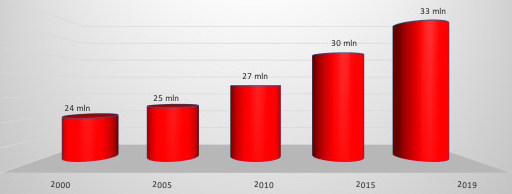
During the first decades of the twenty-first century, the phenomenon of migrating minors, alone or with their families, has taken on an increasingly quantitative consistency in the world, going from 24 million in 2000 to 33 million in 2019 (Unicef, 2020).
Figure 1 - Number of migrant minors from 2000 to today
(Source: UNICEF, Child Migration, April 2020)
In Italy, the issue of the reception – and protection – of these minors appeared since the late 1990s, especially because of the strong impact that minors have on the welfare system. In fact, their presence has transformed educational agencies and, in particular, socio-educational services aimed at minors, influencing the organizational, as well as the more specifically managerial aspects. Recent years have seen a considerable increase in the number of unaccompanied foreign minors, that is, without any adult supervision, who arrived in the countries of the European Union, especially Italy and Greece, as a result of the important socio-political changes occurred in different areas of the Middle East, North Africa and sub-Saharan Africa, to the point of becoming an important segment of the immigrant population.
Migrating with their own parents or reuniting with them, after a few years of separation due to migration, has therefore the need to redefine their world of relationships and affections, trying to cope with the stressful situation that inevitably accompanies the great changes in life (Berry, 2006).
And one of the characteristics that could be considered common in the experiences – albeit different – of these young migrants is vulnerability, as Pope Francis also emphasized in his message on the occasion of the 103rd World Day of Migrants and Refugees, in 2017. Vulnerability is a consequence of the novelty and diversity of the living environment.
Novelty and diversity
The category that qualifies every migration story is novelty. A novelty that, for the migrant minor, affects him/her in some specific areas: a new language; a new school, that is, a new way of learning (Bartlett, 2015); a new way of thinking about himself/herself (Perez et al., 2021); a new future, very different from the one dreamed before migration.
Particularly crucial for a migrant minor is the language issue. Learning a language means not only being able to express oneself, but also opening oneself to get to know other cultures and have access to other worldviews. Knowing languages and cultures is also a necessary condition to strengthen relationships and bonds and to break down barriers that create separation and discrimination (Canagarajah, 2017). In the migratory context, knowing the language of the host country means not only having the opportunity to move independently and to meet one’s basic needs, but also to fully participate in the society and to interact in situations where duties and rights are at stake. It is also because of these considerations that many Catholic organizations, such as Caritas, and many parishes have provided opportunities for them to learn the language of the local people.
A second factor of vulnerability for the migrant minor comes about because of the diversity of his/her new living environment. A diversity that must be faced and lived by everyone with an intercultural approach [cf. the entry Interculturalism and migration processes], as the documents of the Magisterium of the Church have always pointed out (cf. Gaudium et spes, 1966, 27; Erga migrantes caritas Christi, 2004, 30); an approach that chooses values that unite and refuses to take into consideration only differences that separate, to achieve a peaceful and constructive coexistence. The primary goal of an intercultural education involves not only the acceptance and respect of the different person, but also the recognition of his/her cultural identity in the daily search for dialogue, understanding, collaboration, in a perspective of mutual enrichment.
Respect for the dignity of minors
The Church’s social doctrine has always highlighted the need to respect the dignity of minors, especially when they find themselves in a condition of vulnerability, such as migrant minors do. «In the family, which is a community of persons, special attention must be devoted to the children by developing a profound esteem for their personal dignity, and a great respect and generous concern for their rights. This is true for every child, but it becomes all the more urgent the smaller the child is and the more it is in need of everything, when it is sick, suffering or handicapped» (Familiaris consortio, 1981, 26). The rights of children must therefore be protected by the legal systems. And it is therefore necessary, above all, that in all countries the value of childhood might have a public recognition: «no country on earth, no political system can think of its own future otherwise through the image of these new generations that will receive from their parents the manifold heritage of values, duties and aspirations of the nation to which they belong and of the whole human family» (John Paul II, Letter to the Secretary-General of the United Nations Organization on the occasion of the World Summit for Children, September 22, 1990). Unfortunately, the condition of a large part of children in the world is far from being fair, due to the lack of opportunities enhancing their development, despite the existence of a specific international legal system aimed to protect the rights of children, which includes almost all the members of the international community and which the Holy See itself has ratified. These conditions refer to the lack of health services, home, adequate nutrition, and education. Moreover, some very serious problems are still unresolved: child trafficking, the phenomenon of “street children”, the use of children in armed conflicts, the forced marriage of girls. It is therefore important to combat, at national and international level, violations of the minors’ dignity. These are criminal acts that must be countered, the Magisterium reiterates, with adequate preventive measures, by a decisive action of the States.
Migrant minors, “three times vulnerable”
Pope Francis, on the occasion of the 103rd World Day of Migrants and Refugees, in 2017, wanted to draw attention to the reality of migrant minors, especially those who are alone, indicating some necessary actions and urging everyone to take care of these minors, who are three times vulnerable: because they are minors, because they are foreigners, and because they are helpless, when, for various reasons, they are forced to live far from their homeland and separated from family affections. In fact, as the Pope emphasizes, it is in the first place minors, who pay the heavy costs of migration, almost always caused by violence, poverty and environmental conditions, factors to which globalization is associated in its most negative aspects. The unbridled race for quick and easy gains also involves the insurgence of plagues such as child trafficking, the exploitation and abuse of minors and, in general, the deprivation of rights enshrined in the International Convention on the Rights of the Child.
What to do?
Pope Francis underlines the need to center the activity on three focuses: the protection of migrant minors, their integration into society, and the establishment of lasting solutions.
First of all, it is a matter of taking every possible measure to guarantee protection for migrant minors, to prevent them from becoming prey to ruthless exploiters. After all, the dividing line between migration and human trafficking can sometimes be very thin. There are many factors that contribute to creating a state of vulnerability in migrants, especially if they are minors. But the most powerful push for minor’s exploitation comes from unscrupulous individuals who take advantage of their condition. It is therefore necessary to intervene - the Pope recommends - with greater rigor and effectiveness against exploiters, otherwise the multiple forms of slavery which migrant minors are victims of cannot be stopped.
Secondly, we must operate for the integration of migrant children and young people. They depend entirely on adults and, very often, the lack of financial resources becomes a hurdle to the adoption of adequate reception and inclusion policies. Consequently, instead of encouraging their integration or promoting assisted return programs, they only try to prevent their entry, thus encouraging the use of illegal networks, or they are sent back to their country of origin with no knowledge that this is for their actual “best interests”. The situation of migrant minors is even more serious when they are in a state of irregularity or when they are hired by a criminal organization. In such cases, the right of States to manage migratory flows and to safeguard the national common good must be combined with the duty to resolve and regularize the position of migrant minors, with full respect for their dignity.
The adoption of appropriate national procedures and cooperation agreements between the countries of origin and arrival are essential, aiming at eradicating the causes of forced emigration of minors.
Thirdly, the Pope urges everyone to adopt lasting solutions. As this is a complex phenomenon, the issue of migrant minors must be tackled at its roots: wars, human rights violations, corruption, inequality, poverty, and environmental disasters are part of the causes of the problem. And minors are the first ones to suffer from them.
Concluding remarks
The involvement of minors in migration processes is currently increasing, and this should determine, in host societies, conditions that consider their peculiar vulnerability, which deems psychological, social, economic, and cultural factors intertwined.
With the awareness, for Christians, that the phenomenon of migration is also part of the great history of salvation, as Pope Francis reminded in his message for the World Day of Migrants and Refugees in 2017: «This phenomenon constitutes a sign of the times, a sign which speaks of the providential work of God in history and in the human community, with a view to universal communion. [...] The Church encourages us to recognize God’s plan also in this phenomenon, with the certainty that no one is a stranger in the Christian community. Each person is precious; persons are more important than things, and the worth of an institution is measured by the way it treats the life and dignity of human beings, particularly when they are vulnerable, as in the case of migrant minors».
And with the aim, not only to prevent and combat possible abuses against them, but also to provide them with support and resources for the development of a solid and harmonious personality.
Bibliografia
• Bartlett L. (2015), Access and quality of education for international migrant children, Paper commissioned for the EFA Global Monitoring Report, 2000-2015.
• Berry J. W. (2006), Acculturative stress, in P. T. P. Wong & L. C. J. Wong (eds.), Handbook of multicultural perspectives on stress and coping, Springer, 287-298.
• Canagarajah S. (ed.) (2017), The Routledge handbook of migration and language, Taylor & Francis.
• Pérez I.E., Wu R., Murray C.B., Bravo D. (2021), An interdisciplinary framework examining culture and adaptation in migrant children and adolescents, New directions for child and adolescent development, 2021(176), 13-39.
• UNICEF (2020), Child Migration, April 2020.
Autore
Giovanni Giulio Valtolina, Università Cattolica del Sacro Cuore (giovanni.valtolina@unicatt.it)