

×
Desideri ricevere notizie dal Centro di Ateneo per la dottrina sociale della Chiesa dell’Università Cattolica del Sacro Cuore?

Fascicolo 2025, 3 ‒ Luglio-Settembre 2025
Prima pubblicazione online: Settembre 2025
ISSN 2784-8884
DOI 10.26350/dizdott_000192
di Roberto Moro-Visconti, Jacinta Laker
Abstract:
ENGLISH
L’Uganda ospita il maggior numero di rifugiati in Africa, adottando un approccio inclusivo e basato sui diritti umani. Questo studio analizza il ruolo cruciale della Chiesa cattolica nella risposta umanitaria, promuovendo dignità, integrazione e resilienza. L’esperienza ugandese offre un modello etico e sostenibile per l’accoglienza, fondato su solidarietà, sussidiarietà e sviluppo umano integrale.
Questo articolo intende contribuire alla riflessione nell’ambito del Piano Africa, Università Cattolica del Sacro Cuore
Parole chiave: Sfollati interni, Accoglienza, Chiesa cattolica, Solidarietà, Uganda, Africa, Rifugiati
ERC: SH2 – Institutions, Governance and Legal Systems; SH5 – Cultures and Cultural Production
ITALIANO
Uganda hosts Africa’s largest refugee population, and has adopted a widely admired, rights-based approach to them, centered on inclusion and dignity. This study considers Uganda’s progressive refugee policy in the context of Catholic Social Teaching, focusing on the Church’s work in the areas of education, trauma recovery, and peacebuilding. It deals with aspects such as food insecurity, multi-cultural integration, and spiritual, faith-based associations for comprehensive solutions to global refugee governance.
This article aims to contribute to the reflection within the Africa Plan, Università Cattolica del Sacro Cuore
Keywords: Uganda, Refugees, Internally displaced persons, Human Dignity, Africa, Catholic Church, Solidarity
ERC: SH2 – Institutions, Governance and Legal Systems; SH5 – Cultures and Cultural Production





Introduction
This paper explores Uganda’s remarkable approach to hosting refugees, highlighting how the country – despite its limited resources – has become a global model of rights-based, inclusive refugee policy. Framed within the context of Catholic Social Teaching, it emphasizes the vital role played by the Church in education, trauma recovery, economic empowerment, and peacebuilding. Uganda’s generous and structured response to displacement, especially from South Sudan and Congo (DRC), demonstrates how compassion, memory, and faith-based values can guide national refugee governance toward dignity and solidarity.
Uganda: A Continent of Refuge and a Gospel of Welcome
Uganda hosts Africa’s largest refugee population and has adopted a widely admired, rights-based approach centered on inclusion and dignity.
This paper explores Uganda’s progressive refugee policy through the lens of Catholic Social Teaching, highlighting the Church’s role in education, trauma recovery, and peacebuilding. This policy represents a rare integration of humanitarian openness with long-term social cohesion strategies, offering a living example of subsidiarity and solidarity in action.
Uganda is an unknown example in a world that is too often flooded by migratory crises and reactive policies. The broader issue of mass migration to Europe – evoked in powerful scenes like those in the film Io Capitano – finds echoes in places like Uganda, a poor and landlocked Sub-Saharan country that, despite its challenges, has become a refuge for people escaping war and state collapse elsewhere in Africa.
This gesture of support goes beyond simple charity, reflecting a broader ethic of shared responsibility. It’s a challenge to the rest of the world to change the selfish way we think about migration: as a matter of human solidarity, hospitality, and dignity. Africa is not only a continent people run from; it is a continent they run to that shelters and builds.
A Country Transformed by Memory and Responsibility
Winston Churchill called Uganda, when it was part of the British Empire until 1962, the “Pearl of Africa” for its uncontaminated beauty. With dimensions of 241,000 sq km, comparable to those of continental Italy, Uganda is a small country but carries a massive humanitarian load.
Of the country’s population of about 48 million as of 2025, nearly 1.8 million, more than 3.7 percent, are refugees. This is the highest percentage in any African country and the fourth highest proportion of refugees in the world. That’s how many refugees there are, with little recourse and amazing constraints in both the scale of displacement across the region and the incredible opportunity it provides.
Suppose Italy – home to a population of some 59 million people – were to apply the same proportional consideration, it should make room for over 2.3 million refugees instead of the roughly 520,000 it hosts presently, accepting only 7% of asylum requests.
Inter-Ethnic Diversity and Settlement Realities
Modern Uganda is a mosaic of more than 50 recognized ethnic groups, all with their language (cemented by English as the official lingua franca), ancestral culture, and social order. This variety, while a source of national richness, also poses challenges in terms of governance, resource allocation, and social cohesiveness among conflicting ethnic groups.
The diversity in refugee camps is a complicated puzzle. Most places near the North (bordering South Sudan) and East (bordering Congo) were opened to refugees arriving from various national, ethnic, and linguistic backgrounds. Peace and reconciliation efforts from the settlement authorities and humanitarian organizations, in collaboration with the Catholic Church, organize intercultural dialogue sessions, peacebuilding workshops, and youth exchanges to help alleviate the physical deprivation.
Ugandans have always been open to refugees. This is in part because Uganda has a history of displacement. Political strife and war in the 1970s (under Idi Amin Dada) and 1980s (during the civil war between the North and South) prompted thousands of Ugandans to flee to neighboring countries. A shared cultural memory of receiving help fosters a moral drive to pay it forward. Still, tensions can arise – especially over scarce resources like water, firewood, and land in areas like Karamoja – where drought or economic hardship intensifies competition between host communities and refugees.
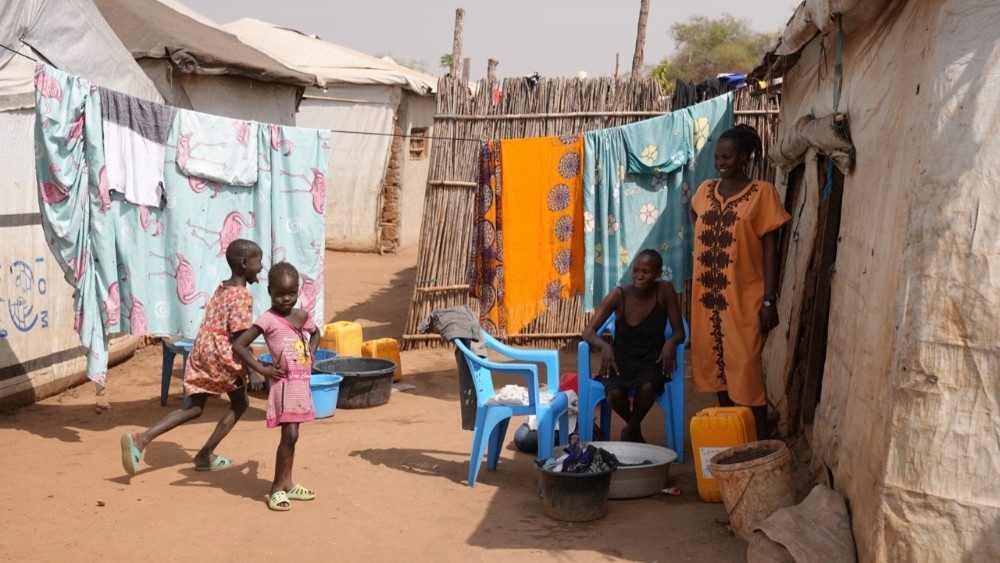
In a refugee settlement on the outskirts of Juba, South Sudan’s capital (Vatican News)
Hosting Congolese or South Sudanese Communities escaping from war
More than a million refugees come from the war-torn country of South Sudan (close to Darfur, where forgotten conflict is surging back), where the country has been held captive for decades by civil war, ethnic violence, and food shortages, up to man-induced famine. The abrupt split from North Sudan in 2011 did not improve matters.
In recent years, outbreaks of endemic diseases like Ebola, malaria, TBC, AIDS, cholera and yellow fever have worsened the vulnerability of refugees fleeing conflict zones.
Uganda is one of the largest refugee-hosting nations in the world, with 1,852,002 refugees (as of 23 May 2025, https://data.unhcr.org/en/country/uga). The vast influx of refugees is due to several factors in Uganda’s neighboring countries, especially war and violence in Sudan, South Sudan, and the Democratic Republic of the Congo.
Figure 1 - Number of violent events, 1 december 2024 - 27 april 2025
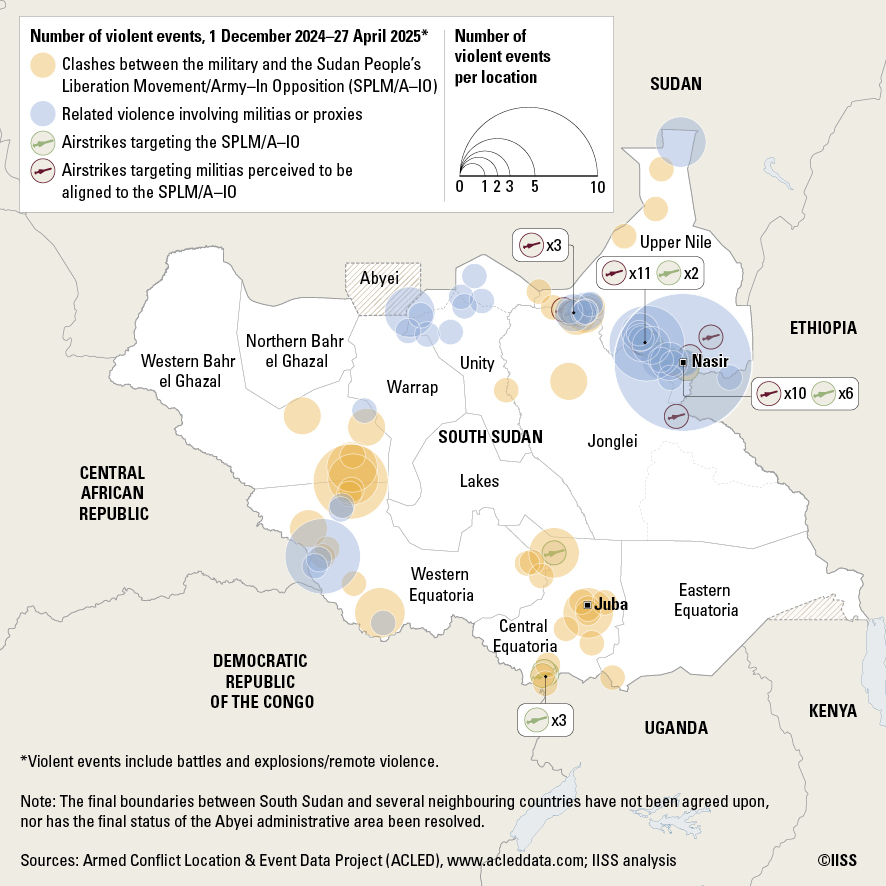
Source: Armed Conflict Location & Event Data Project (ACLED), www.acleddata.com; IISS analysis
Many are fleeing the DRC, which is still mired in conflict, especially in North Kivu, South Kivu, and Ituri. A consequence of the instability is the re-emergence of the rebel movement M23, which was responsible for war crimes and mass displacement, resurgent since Spring 2025. Uganda, sharing a porous western border with the resource-rich North Kivu region, has a long and complex history of involvement in regional security dynamics. Its engagements in DRC have at times drawn both cooperation and criticism, reflecting the difficulty of navigating longstanding instability and cross-border threats. While Uganda has officially supported peace initiatives and regional stabilization efforts, perceptions among some Congolese communities and leaders remain cautious, shaped by past tensions and unresolved legacies.
Yet despite this complexity, Uganda has consistently maintained an open-door policy toward those fleeing violence, including hundreds of thousands of refugees from the DRC.
Uganda also hosts thousands of people from Burundi, Somalia, Rwanda, and Eritrea. Yet this influx has not dampened Uganda’s generosity. Instead, it has perpetuated a system founded on a progressive, rights-based model of protection.
Camp settlements
The largest settlement is Bidibidi in Yumbe District (in the far northwestern corner of west-Nile Uganda, just south of the border with South Sudan), which accommodates hundreds of thousands of people and is the largest refugee settlement in Africa. The figures are 124,000 in Palorinya and Moyo District, and 50,000+ have already been registered in Rhino Camp (Arua diocese, run by bishop Sabino Odoki) and Palabek (Gulu archdiocese, headed by bishop Raphael P’Mony Wokorach, and till 2024 by bishop John Baptist Odama, a charismatic leader in peace talks), among others.
A good number of refugees live in Arua and Gulu City, as well as the neighboring districts within the region. These settlements, though, are meant to be open, not camps in the traditional sense. Refugees are provided a plot of land to farm for crop production and build a house on it. They are also provided with access to social services, health care, and education alongside the nationals to promote self-reliance and make refugees a part of local government-managed systems. Refugees can settle in cities legally, move freely, work, and open small businesses. But despite these limitations, Uganda also has the most liberal refugee policy in the world. The national law and policy, notably the Refugees Act of 2006 and the Refugee Regulations of 2010, are grounded in a human rights paradigm, in which refugees have access to a great range of rights and services.
Uganda’s reserves of empathy are formed as much through faith as through memory: from 1986 to 2006, the country’s north was devastated by a ruthless insurgency waged by the rebel Lord’s Resistance Army and his leader Joseph Kony, whose enduring legacy of child soldiers, mass abductions and vast, militarized I.D.P. camps –%E2%80%82rom this perspective, far harsher than today’s gentler, bluer settlements – has cut deep wounds still visible on the national psyche.
The refugees can work, travel, and use public services. Shared services and public schooling facilitate interaction with the host community.
The graph below represents the actual situation.
Figure 2 - Uganda - Refugee Statistics Map May 2025
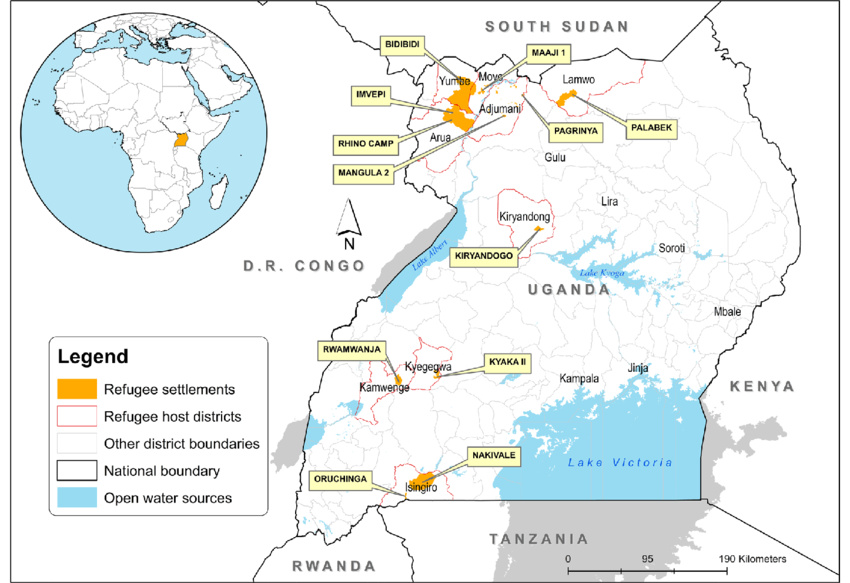
Source: https://data.unhcr.org/en/
Empowerment Opportunities
Refugee settlements often struggle with unstable incomes and fragile, climate-sensitive economies. Microfinance tools like self-help groups – when rooted in cooperative values – can empower refugees, especially women, to launch micro-enterprises, boost resilience, and engage in the local economy.
The Catholic Church, through Catholic Relief Services (CRS), Caritas Uganda, and other diocesan programs, has supported such initiatives by providing seed capital, training, information sharing, organizing, setting structure, and spiritual accompaniment. This aligns with Caritas in veritate, where Benedict XVI emphasizes that fraternity, ethics, and solidarity must guide economic development, and the pontificate of John Paul II (1978-2005), which recognizes that no satisfactory solution to the human crisis will ever be found without the assistance of the church. In Uganda, teaching is practical and widely recognized, promoting dignity, equality, credit access, and shared responsibility as pillars of inclusive, sustainable economic participation.
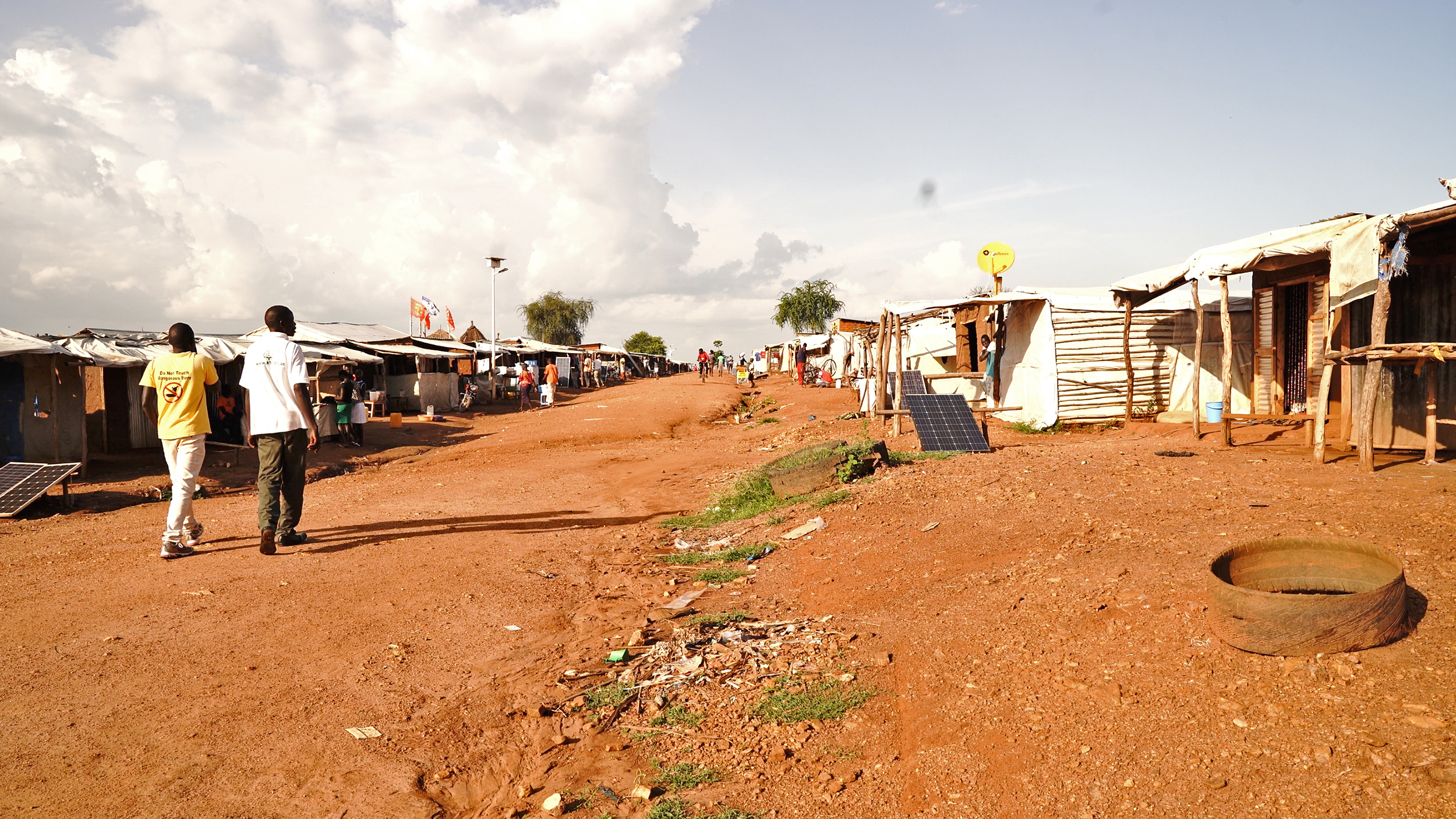
Bidi Bidi settlement
By Frenciscobcn - Own work, CC BY-SA 4.0, in Wikipedia
The Church as Mediator and Supporter
Uganda’s policy reflects principles of Catholic Social Teaching – human dignity, solidarity, and care for the poor – ensuring respect and compassion regardless of status. The Catholic Church, through CRS, Caritas, missionaries like the Comboni, and other bodies, plays a key role in fostering peace and supporting refugees with health care, education, counseling, and spiritual care to promote self-reliance and integration.
Church-run schools often have more teachers and resources than public schools, even those in crowded settlements like Palabek and Adjumani. Catholic-run health clinics (like Saint Mary’s Lacor hospital in Gulu, St. Joseph’s hospital in Kitgum, Kalongo’s Dr. Ambrosoli Memorial hospital in the Agago district, Arua diocese, and health centers in Adjumani, Padibe, and Palabek parishes) provide the only reliable maternal and delivery care and HIV treatment services, attracting patients from remote refugee camps.
Parishes and religious compounds, in fact, feel like an enclave of community and continuity for families driven from home by a ruthless war. They have provided shelters, water, spiritual nourishment/encouragement, and sometimes food for refugees on arrival.
Catholic Social Teaching, as articulated in seminal writings like Rerum novarum (1891), Populorum progressio (1967), and Fratelli tutti (2020), develops such a framework regarding refugee protection. It upholds the dignity of the person, solidarity, the common good, and the option for the blessed poor. In Uganda, these are not theoretical values. They guide bishops defending refugee land rights, nuns building trauma centers for survivors, and lay groups providing education and vocational training to refugee youth.
Doctrinal Reflections and Papal Appeals
The Church’s deep historical and spiritual ties to Uganda further reinforce its credibility and effectiveness. The pastoral visits of Pope Paul VI in 1969 – his first to Africa – underscored the universal Church’s attention to the dignity and potential of the African continent. His appeal for “Africans to be missionaries to themselves” resonates today in the self-help ethos of refugee communities. Similarly, Pope John Paul II’s visits in 1989 and 1993 highlighted themes of peace, justice, and reconciliation – principles that underpin the Church’s current efforts in economic inclusion. Local initiatives reflect Deus caritas est, where Pope Benedict XVI emphasized that the Church must “do everything in its power” to train and equip those who care for people in need.
During his 2023 visits to the D.R.C. and South Sudan, Pope Francis highlighted refugee dignity, peacebuilding, and global economic injustice. He called for ethical political responsibility and reinforced Uganda as a model where Catholic teaching meets lived reality.
Food Insecurity
Yet the hurdles are as formidable as ever. Food insecurity is now at a crisis level. In 2024, the World Food Program (WFP) cut rations to 30% for many refugees due to a lack of funding. Its children face sky-high rates of malnutrition, and more and more families are simply going without. Complaints are multiplied by a lack of drinkable water: most settlements rely on boreholes that are overused and tend to empty in the dry season. There is too little sanitation, and the one-two punch of infectious disease and mental health crisis badly stresses the systems of health care. In early 2025, the abrupt termination of USaid, following shifting geopolitical priorities, delivered a significant blow to Uganda’s already strained refugee support system, leaving many essential programs scrambling to secure alternative funding.
Living the Gospel Through Radical Hospitality
This spiritual vision of poverty as a locus of dignity and hope finds profound expression in the Christian tradition, culminating in Jesus’s teachings. In the Sermon on the Plain, Christ’s words in Luke 6:20 – ’Blessed be ye poor: for yours is the kingdom of God’ – do more than recognize material poverty; they elevate it as a privileged place of grace and divine favor.
In this context, theology becomes action, and migration becomes not only a test of systems but a field of grace.
Isaiah 63:9 ‘In all their affliction he was afflicted’ echoes in Uganda’s refugee settlements, transforming spiritual insight into a call for compassionate and just policy action.
The Catholic Church, in its Social Teaching, insists that the poor are not the objects of charity from a distance but are the hope-bearers, the beneficiaries of justice, solidarity, and structural embrace; they are the hope-carriers God uses to save us all. This echoes Pope Francis’s message in Fratelli tutti , where He writes that the poor must be the ‘active protagonists’ of their development, not simply its ‘passive’ beneficiaries. Uganda’s generous embrace of refugees – many of whom arrive with nothing – reflects that kind of radical hospitality, which is not constrained by humanitarian limits but is at the very heart of the Gospel.
Spiritual and humanitarian teachings
Uganda’s refugee model, grounded in Catholic Social Teaching, demonstrates how faith can shape practical, inclusive governance. Greater international investment is needed in sustainable infrastructure and integration. Church-state partnerships play a key role in delivering vocational training, mental health support, and youth empowerment. The principle of subsidiarity is evident in refugee-led governance, which promotes accountability and participation. The Church mediates daily between host communities and refugees, defending human dignity and fostering reconciliation. Uganda shows that when compassion and shared responsibility are lived values, they can reshape both policy and society. In the end, Uganda does more than offer a welcome: it testifies to the success of a compassionate policy. Its refugee response is by no means perfect. As international observers have pointed out, facilities to deal with the host of people turning up in need could be better run. But at its core, these are values that the Catholic Church has long espoused: solidarity, peace, justice, and the sanctity of life. If the world is to meet the challenges of forced displacement in a fair manner, it would be wise to look at Uganda, not to pity its condition, but to admire it and to assume “burden-sharing” as a common duty.
Bibliografia
• Bamidele S., Pikirayi I. (2024), African Union Kampala convention: The continuing dialogue on the protection of internally displaced persons in Sub-Saharan Africa, «Journal of Asian and African Studies», 60, 5.
• Böcker A., Hunter A. (2025), Older refugees and internally displaced people in African Countries: findings from a scoping review of literature, «Journal of Refugee Studies», 38(1), 16-30.
• Serwajja E., Refstie H. (2023), Self-reliance and refugee economics in Uganda, in Handbook on Forced Migration, Edward Elgar Publishing, 363-376.
Autori
Roberto Moro-Visconti, Università Cattolica del Sacro Cuore (roberto.morovisconti@morovisconti.it)
Jacinta Laker (jalaker@ush.ac.ug)