


×
Desideri ricevere notizie dal Centro di Ateneo per la dottrina sociale della Chiesa dell’Università Cattolica del Sacro Cuore?

Fascicolo 2026, 3 ‒ Luglio-Settembre 2026
Prima pubblicazione online: Settembre 2026
ISSN 2784-8884
DOI 10.26350/dizdott_000219
Abstract:
ENGLISH
Il contributo analizza la necessità di una valutazione etica strutturata dell’intelligenza artificiale alla luce della ricerca contemporanea e della dottrina sociale della Chiesa. Dopo aver richiamato i principali limiti dell’IA attuale e i fondamenti antropologici del Magistero, l’articolo propone l’istituzione di un Osservatorio e di un Comitato Etico-Scientifico, insieme a un’etichetta etica, come strumenti operativi di dialogo tra scienza e visione cristiana per orientare l’innovazione al bene comune.
Parole chiave: Intelligenza artificiale, Valutazione etica, Dottrina sociale della Chiesa, Governance tecnologica, Dignità umana
ERC:
ITALIANO
The contribution analyzes the need for a structured ethical evaluation of Artificial Intelligence (AI) in light of contemporary research and the Social Doctrine of the Church. After outlining the main limitations of current AI and the anthropological foundations of the Magisterium, the article proposes the establishment of an Observatory and an Ethical-Scientific Committee, together with an ethical label, as operational tools for dialogue between science and the Christian vision, aimed at guiding innovation toward the common good.
Keywords: Artificial Intelligence, Ethical Evaluation, Social Doctrine of the Church, Technological Governance, Human Dignity
ERC:





1. The Ethical Evaluation of AI in Contemporary Research
The growing pervasiveness of Artificial Intelligence (AI) makes it increasingly evident that technological progress cannot be assessed solely in terms of efficiency or innovation.
The central issue concerns rather the way in which these technologies transform human relationships, work, education, and forms of social participation. In this context, the dialogue between scientific research and the Social Doctrine of the Church can offer an original contribution: not as a limitation to technological development, but as a guiding perspective capable of safeguarding the centrality of the human person and the common good.
This contribution adopts an interdisciplinary perspective, integrating technological, anthropological, and ethical-social dimensions into the reflection on artificial intelligence, with particular attention to the definition of operational tools for ethical discernment and governance.
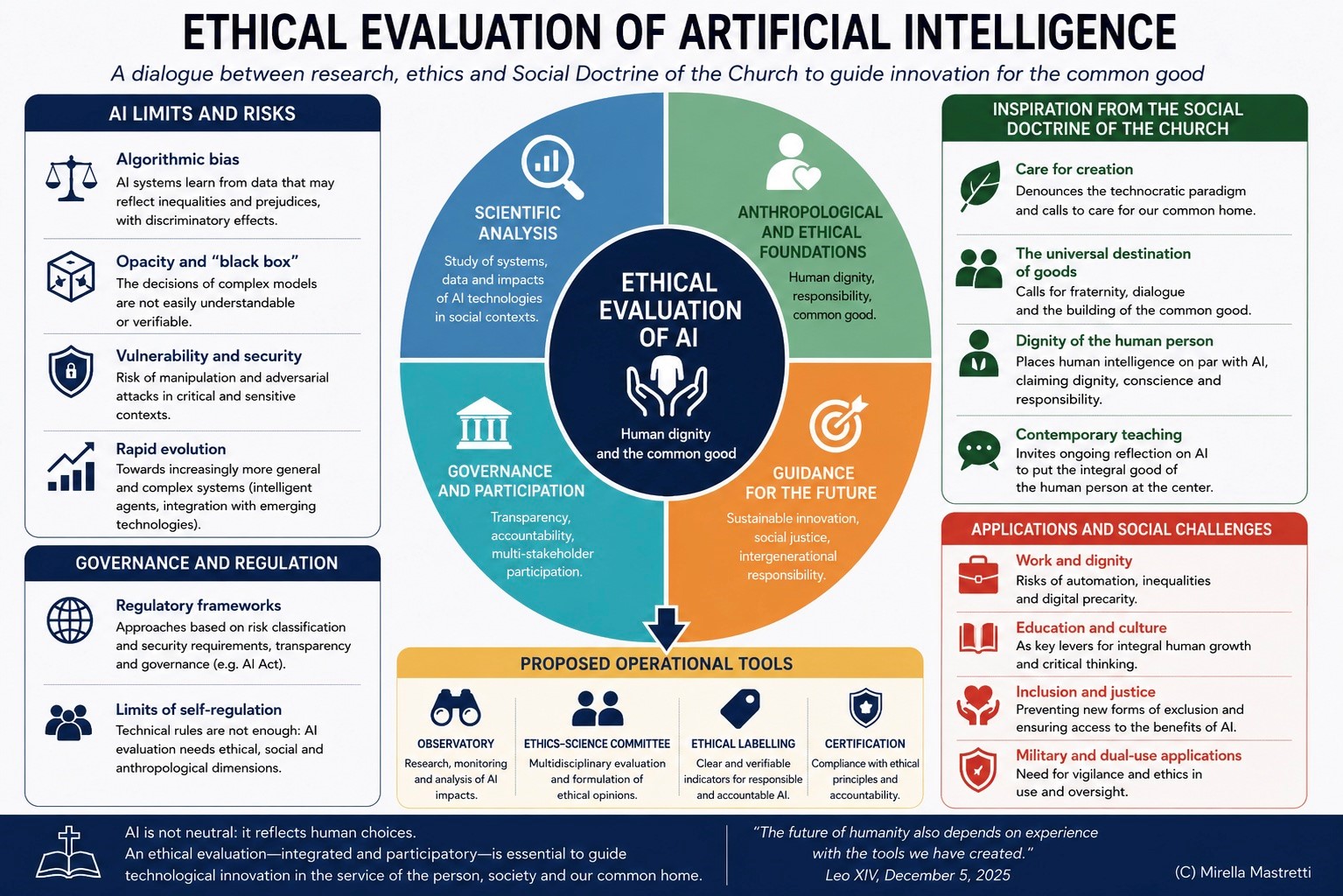
1.1. Structural Limits and Algorithmic Bias
Artificial intelligence (AI) is today one of the main drivers of technological and social transformation. Its applications range from medicine to finance, from law to digital media, increasingly influencing decision-making processes, social relations, and people’s living conditions. This development raises significant questions that are not only technical but also ethical, anthropological, and normative.
Current AI systems largely fall within the paradigm of Artificial Narrow Intelligence (ANI): highly specialized systems capable of performing specific tasks but lacking semantic understanding, awareness, and intentionality. This condition entails structural limitations of particular relevance.
A primary limitation concerns the presence of algorithmic bias. Models are trained on large datasets that often reflect preexisting social inequalities and prejudices. This may result in discriminatory outcomes, especially in sensitive areas such as healthcare, hiring processes, credit access, and predictive justice (Fabris et al., 2025).
1.2. Opacity, Security, and Emerging Developments
Another significant limitation is the opacity of complex models, often referred to as the “black box” effect. In deep neural networks, the decision-making process is not easily traceable, making it difficult to understand outcomes, challenge decisions, or assign responsibility.
Another critical issue is the vulnerability of AI systems to manipulation and adversarial attacks, whereby minimal modifications to the input data can produce significant errors. In high-risk contexts, such as medical devices or critical infrastructures, these vulnerabilities become particularly serious.
At the same time, rapid technological progress and substantial financial investment are already giving rise to more advanced intermediate scenarios, informally referred to as “Weak General AI”, “Proto-AGI”, and other related concepts.
These AI systems exhibit emerging general capabilities, forms of integrated reasoning across different contexts, limited planning abilities, and the capacity to interact with external tools. They represent the new generation of “intelligent agents”, long anticipated in AI research but now becoming a central paradigm in the field.
The evolution of AI towards increasingly sophisticated systems opens up scenarios that remain difficult to predict, particularly with regard to the future integration of neuro-symbolic approaches and quantum technologies. Such developments could substantially expand the cognitive capabilities of artificial systems while simultaneously increasing the complexity of their ethical and societal implications.
In recent years, several supranational organisations have introduced regulatory frameworks governing the development and deployment of AI, based on risk classification and requirements for safety, transparency, and governance. However, legal and technical regulation alone is insufficient to address the deeper questions concerning the meaning and value of technological choices. This highlights the need for a structured ethical evaluation capable of integrating technical, social, and anthropological dimensions.
Given the scientific and technological complexity of AI, together with its exponential rate of development, establishing meaningful correlations between ethical principles and technological solutions remains an enormous challenge.
This challenge is further compounded by the fact that AI is regarded as strategically important by both governmental institutions and major commercial actors. Consequently, information concerning algorithms, training data, system architectures, constraints, and additional governing rules is often not readily accessible.
1.3. Governance and Responsibility of Research
Another critical challenge is the philosophical, even more than the technical, difficulty of formalising rules and criteria capable of defining an ethically acceptable framework, if not universally, at least within specific application domains.
Despite the considerable research effort required, the ethical evaluation of present and future AI systems remains of paramount importance. We are facing a new revolution – one that is not only technological but also social and cultural in its impact at every level, and whose consequences remain, in many respects, unpredictable.
Contemporary research, particularly within academia, is still relatively limited with regard to analyses specifically focused on ethical issues in the field of AI. The industrial sector, on the other hand, should promote implementation-oriented approaches, developed in cooperation with academic research, that make compliance with ethical principles more transparent and traceable.
In this regard, the contribution of Catholic universities goes beyond the mere coexistence of different disciplines, although such interdisciplinarity is already present in many academic settings. Rather, it is grounded in a shared anthropological vision capable of guiding ethical reflection within an integral and coherent understanding of the human person. This perspective is particularly significant in the contemporary debate on value alignment, where the crucial question is not simply how to embed values into Artificial Intelligence systems, but rather which conception of the human person and of the common good should guide that process. As Hasselberger and Lott (2023) observe, artificial systems may be programmed to conform to particular values, but they cannot possess or truly understand them in the sense proper to human action, which necessarily involves consciousness, freedom, and moral responsibility.
Consistent with Pope Francis’ reflections on the technocratic paradigm (cf. Laudato si’ , 2015; Fratelli tutti, 2020), the principal risk lies not merely in the misuse of AI, but in a broader cultural transformation in which human relationships, education, work, and decision-making processes are progressively reduced to the logic of efficiency, optimisation, and prediction.
From this perspective, technology is no longer regarded simply as a tool, but increasingly as the dominant organising principle of social life.
2. The Social Doctrine of the Church and AI
2.1. Anthropological Foundations
The Catholic Church recognises the positive potential of Artificial Intelligence while firmly drawing attention to the risks associated with its development and use. In particular, it warns against transhumanist perspectives that seek to redefine or transcend human nature, thereby undermining the very meaning of the human person.
By contrast, the Christian vision is directed towards safeguarding and promoting the human person in his or her fullness, in the light of an irreducible dignity, rather than transcending or replacing human nature.
From this perspective, several fundamental points of divergence emerge, including the gradual loss of the sense of gift and gratuitousness, the weakening of authentic empathy, and the reduction of self-awareness and self-determination to mere operational functions.
The Church’s reflection on the ethical evaluation of Artificial Intelligence is rooted in a well-defined anthropological vision according to which every human person possesses an intrinsic and inalienable dignity that does not depend on efficiency, performance, or productivity. This dignity is the foundation of inviolable rights and of a moral responsibility that no technology can replace or replicate.
As Pope Francis has repeatedly emphasised, technological innovation must always be directed towards the good of the human person and of communities, and never the other way around. In this regard, he also stresses that Artificial Intelligence is never value-neutral, since it inevitably embodies the values, choices, and assumptions of its designers, and may therefore reinforce patterns of injustice unless it is properly guided and governed.
From an anthropological perspective, Christian anthropology draws a clear distinction between human intelligence and Artificial Intelligence. The former is characterised by consciousness, freedom, and the capacity for moral discernment, whereas the latter operates through computational processes devoid of interiority, intentionality, and moral responsibility (cf. Antiqua et Nova, 2025).
2.2. Work, Education, and Responsibility
The Church defends the centrality of work, considering challenges such as cognitive automation, the replacement of creative labor by AI-generated outputs, and new forms of digital precarity.
While not opposing technological progress, the Social Doctrine of the Church insists that work is a fundamental dimension of the human person, not merely a productive factor.
This perspective is expressed especially in Saint John Paul II’s Laborem Exercens (1981) and in Pope Francis’ reflections on the technocratic paradigm and the social effects of digital technologies presented in Laudato si’.
Pope Leo XIV calls for greater caution in the use of AI, emphasizing the protection of human dignity and relationships. He highlights the importance of educational responsibility toward younger generations (see also Hasselberger and Gregorio in this issue), noting that technology can support learning but must not replace critical and autonomous thinking.
These new tools are undoubtedly valuable, but they must be used wisely, always in the pursuit of truth and while preserving personal responsibility.
Pope Leo XIV therefore calls on researchers, developers, and decision-makers to cultivate justice, solidarity, and respect for human life in the design of AI systems. He also urges that AI ethics should not be confined to research laboratories or corporate boardrooms, but should become an integral commitment of the Church and society as a whole.
In his Address to participants at the Conference “Artificial Intelligence and Care of Our Common Home” (2025), Pope Leo XIV emphasized that AI development must be oriented toward the common good rather than the concentration of power in the hands of few.
He reaffirmed the primacy of human dignity as the essential criterion for evaluating the impact of emerging technologies, stressing that human beings are called to cooperate responsibly in the work of creation rather than become passive consumers of technology.
A further significant step forward is represented by Pope Leo XIV’s most recent encyclical, Magnifica Humanitas, signed on 15 May 2026, on the 135th anniversary of Rerum Novarum. The document is centred on the concept of “safeguarding the human person in the age of Artificial Intelligence.”
Researchers, developers, and public decision-makers are called to assume ethical responsibility in the design, development, and use of AI systems. The Pope also invited institutions, universities, and economic stakeholders to promote coordinated and interdisciplinary cooperation in governing technological innovation in a just and solidarity-oriented manner.
Consequently, the ethical evaluation of AI is not an ancillary concern but a direct implication of Christian anthropology: if the human person is always an end and never merely a means, every technological system that affects human life must be assessed in the light of respect for human dignity, freedom, and interpersonal relationships.
From this perspective, the proposal to establish an Observatory and an Ethics and Scientific Committee may be understood as a practical means of translating this call for shared responsibility into concrete governance mechanisms.
Furthermore, recent applications of Artificial Intelligence in the military domain demonstrate how automated decision-making can influence target selection, operational strategies, and human responsibility, further highlighting the urgent need for appropriate ethical and governance frameworks.
3. Personal Perspective: Operational Tools for Dialogue between Research and the Magisterium
3.1. From Norms to Conscience
In recent years, national and supranational institutions have introduced important regulatory frameworks for Artificial Intelligence. In particular, the European Union, through the AI Act (European Union, Artificial Intelligence Act, 2024), has adopted a legal framework based on risk classification and governance requirements.
However, regulation based exclusively on legal and technical criteria is not sufficient to fully address the deeper ethical implications of AI.
While the law defines what is legally permissible, ethical evaluation is concerned with the meaning and purpose of technological choices. In this sense, it complements legal regulation by guiding technological development towards social justice, the protection of vulnerable individuals, and the promotion of the quality of human relationships.
Within this context, ethical evaluation cannot be reduced to a set of general principles. Approaches commonly referred to as “algorethics”, although rooted in important ethical traditions, including the Christian tradition, tend to remain largely at the level of declarative principles. What is needed instead is a shift from principles to processes, capable of translating ethical reflection into concrete mechanisms for evaluation and governance.
3.2. Observatory and Ethical Label
Within this framework, the proposal to establish an Artificial Intelligence Observatory, supported by an Ethics and Scientific Committee, aims to provide stable institutional mechanisms for ethical discernment and guidance. The Observatory would monitor developments in AI and their societal impact, fostering dialogue among academia, public institutions, industry, and civil society, while the Committee would define evaluation criteria grounded in human dignity, the common good, solidarity, and subsidiarity.
The introduction of an ethical certification label for AI systems that demonstrate compliance with requirements of responsibility, transparency, non-discrimination, and meaningful human oversight would represent a distinctive innovation. Such a label would not be legally binding; rather, it would serve as a cultural and ethical point of reference, promoting good practices and strengthening public trust.
Similarly to the role played by the Catholic Principles in the field of ethical finance, this label could provide practical guidance for identifying AI systems and applications that are consistent with the principles of the Social Doctrine of the Church. Although it would have no legally binding force, it could encourage the adoption of systems that comply with shared ethical guidelines and evaluation criteria.
This approach makes it possible to translate ethical principles into concrete evaluation processes, addressing challenges such as algorithmic bias, opacity, and lack of accountability across a wide range of domains – from healthcare and education to business and industry. Through an interdisciplinary approach, it offers an operational framework capable of integrating scientific, regulatory, and anthropological perspectives.
Such an approach leads to structured ethical evaluations, the outcomes of which could be made visible through the proposed ethical labelling scheme, thereby supporting informed decision-making and strengthening public trust. More broadly, the distinctive contribution of these instruments lies in their shared anthropological foundation, rooted in the principles of the Social Doctrine of the Church – particularly the common good and the centrality of the human person. In this way, ethical evaluation becomes a genuine instrument of governance, grounded in a coherent vision of the human person and society. Ultimately, the proposed model provides a shared framework for dialogue between the Magisterium and the scientific community, promoting the development of Artificial Intelligence that is truly at the service of the human person and the common good.
See also: Artificial intelligence: a ‘special’ on Pope Francis’ speech to the G7 (14 June 2024) • The Radical Critique of the “Technocratic Paradigm” in Laudato si’; • Computable Realities. Perspectives and Limits • Ethical and Anthropological Aspects of Artificial Intelligence
Bibliografia
• Fabris A. et al. (2025), Fairness and Bias in Algorithmic Hiring: A Multidisciplinary Survey, «ACM Transactions on Intelligent Systems and Technology», 16(1), Article 16, pp. 1–54. DOI: 10.1145/3696457.
• Caton S., Haas C. (2024), Fairness in Machine Learning: A Survey, ACM Computing Surveys. 2024; 56(7): Article 166, 1-38. DOI: 10.1145/3616865
• European Parliament and Council of the European Union (2024), Regulation (EU) 2024/1689 of 13 June 2024 laying down harmonised rules on artificial intelligence (Artificial Intelligence Act), Official Journal of the European Union. 2024; L 2024/1689.
• European Commission (2025), Guidelines on the scope of obligations for providers of general-purpose AI models under the AI Act, Directorate-General for Communications Networks, Content and Technology (DG CONNECT).
• European Commission (2026), Draft Commission guidelines on the classification of high-risk AI systems.
Autore
Mirella Mastretti (prof.mastretti@gmail.com)